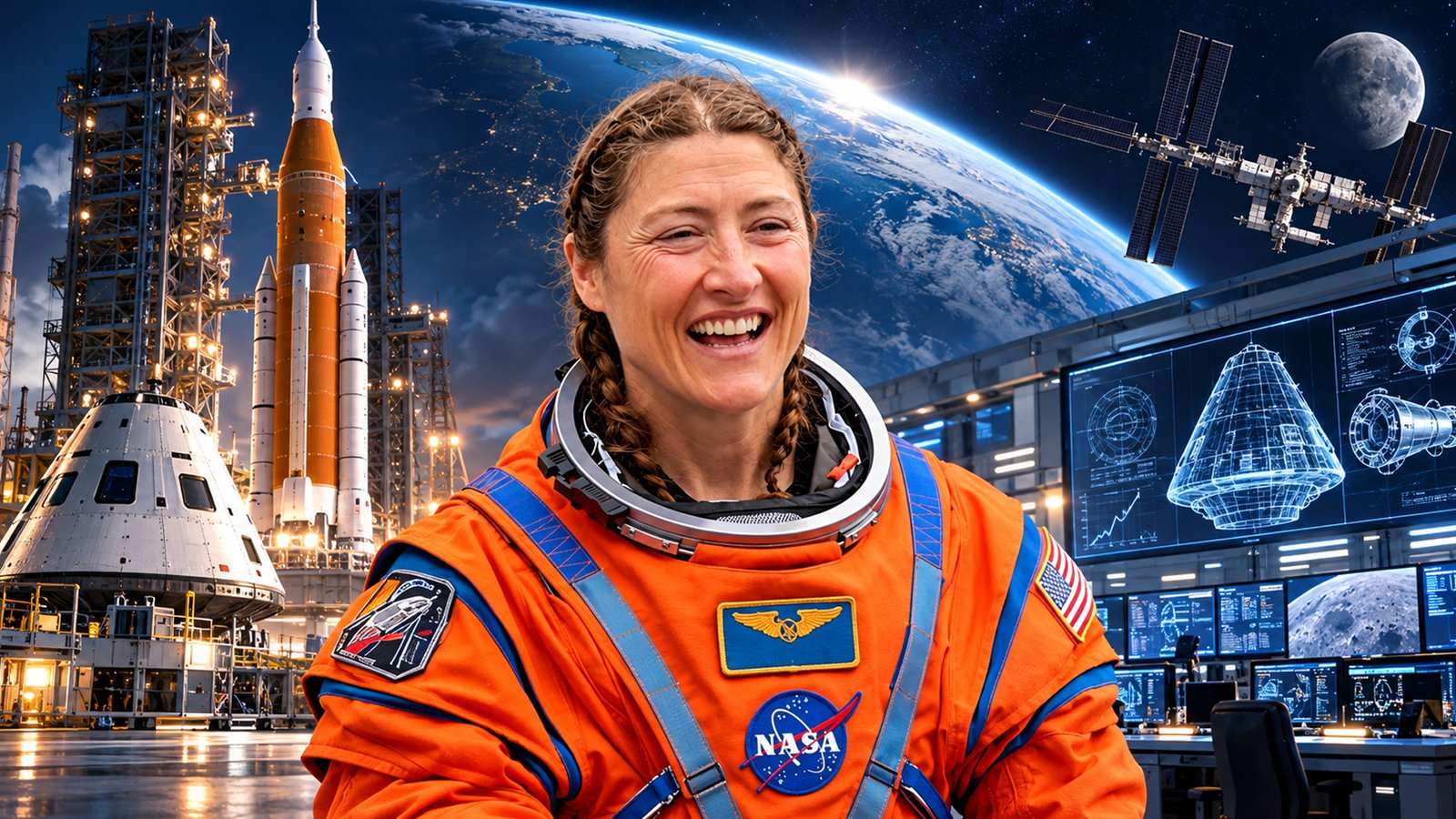
NASA astronaut Christina Koch, who recently travelled around the Moon on the Artemis II mission, is moving into a senior engineering leadership role that will take her away from future spaceflight assignments. The US space agency has named Koch its acting deputy chief engineer, with her appointment taking effect on November 1.
NASA announced the decision on October 13, saying Koch would help lead its engineering community and oversee technical standards, mission readiness and engineering excellence across its programmes and projects. She will succeed Katherine Van Hooser, who is retiring on October 21 after more than 35 years with the agency.
The appointment marks a major transition for Koch, an electrical engineer whose career has combined technical work on the ground with experience in some of NASA’s most demanding human spaceflight missions. Under the new role, she will move into management astronaut status and will no longer be eligible for future spaceflight assignments.
NASA Administrator Jared Isaacman said Koch understood engineering from both sides: developing complex systems on Earth and relying on them for survival in space. Her technical background, operational experience and judgement, he said, would be valuable as the agency prepares for its next phase of lunar exploration and works towards longer-term missions to Mars.
From engineering laboratories to space
Koch began her NASA career as an electrical engineer at the Goddard Space Flight Center in Greenbelt, Maryland, where she worked on scientific instruments for space missions. Before joining the astronaut corps, she also gained experience as a scientific field engineer in Antarctica and the Arctic.
She was selected as a NASA astronaut in 2013. Her engineering background and experience working in remote and challenging environments later helped shape her career in human spaceflight.
Koch became widely known in 2019 after spending 328 consecutive days aboard the International Space Station (ISS). The mission set a record for the longest single spaceflight by a woman, demonstrating the demands of extended stays in orbit and the importance of maintaining crew health and operational readiness.
During her time on the ISS, she also participated in the first all-female spacewalks alongside fellow astronaut Jessica Meir. These missions involved work outside the space station, requiring detailed preparation, technical precision and close coordination between astronauts and ground teams.
Her experience offered a perspective that few engineers possess: understanding how spacecraft systems perform not only during development and testing, but also when astronauts depend on them in space.
A historic journey around the Moon
Koch most recently served as a mission specialist on NASA’s Artemis II mission in April 2026. The flight carried four astronauts on a journey around the Moon, marking the first crewed lunar mission in more than 50 years.
The crew included NASA astronauts Reid Wiseman, Victor Glover and Koch, along with Canadian Space Agency astronaut Jeremy Hansen. The mission travelled beyond Earth orbit and tested systems intended to support future human exploration of the Moon.
Artemis II was an important step in NASA’s broader effort to return astronauts to the lunar surface and establish the capabilities needed for more sustained exploration. Koch’s participation also made her the first woman to travel on a crewed mission around the Moon.
Her new appointment comes as NASA works towards future lunar missions, plans for a Moon base and the development of technologies that could support eventual human missions to Mars. The agency is also exploring nuclear power systems for use in space.
Koch’s experience aboard Artemis II is expected to inform her work in engineering oversight, particularly in evaluating the systems and procedures needed to make complex missions safe and reliable.
Taking over a key engineering role
Koch will replace Van Hooser, whose career at NASA began in 1991 at the Marshall Space Flight Center in Huntsville, Alabama. Van Hooser worked on liquid rocket engine turbomachinery before becoming chief engineer for the Space Shuttle main engine, helping guide engineering efforts through the final 21 shuttle flights.
She later became the first chief engineer for the Space Launch System’s Liquid Engines Element, contributing to the propulsion systems supporting NASA’s Artemis programme. Since 2023, she has served as the agency’s deputy chief engineer, providing technical leadership and oversight across its programmes.
NASA Associate Administrator and Chief Engineer Amit Kshatriya praised Van Hooser’s contribution, saying her leadership had helped the agency navigate complex engineering challenges and major transitions. He expressed confidence that Koch would continue the tradition of technical excellence.
A new chapter at NASA
Koch’s move illustrates how astronaut experience can contribute to NASA beyond individual missions. The agency’s engineering leadership is responsible for ensuring that systems meet demanding technical requirements and that risks are carefully assessed before missions proceed.
Her new position will involve supporting engineering decisions across NASA’s programmes, including human spaceflight and robotic exploration. Rather than preparing for another launch, she will help oversee the technical work that makes future missions possible.
For Koch, the change means stepping away from the prospect of another spaceflight after a career marked by record-setting achievements. It also places her in a position to influence the engineering decisions behind NASA’s next generation of exploration.
Her journey from developing scientific instruments to travelling around the Moon has given her a rare combination of engineering knowledge and operational experience. NASA will now draw on that experience as it prepares for its next major milestones in lunar exploration and beyond.