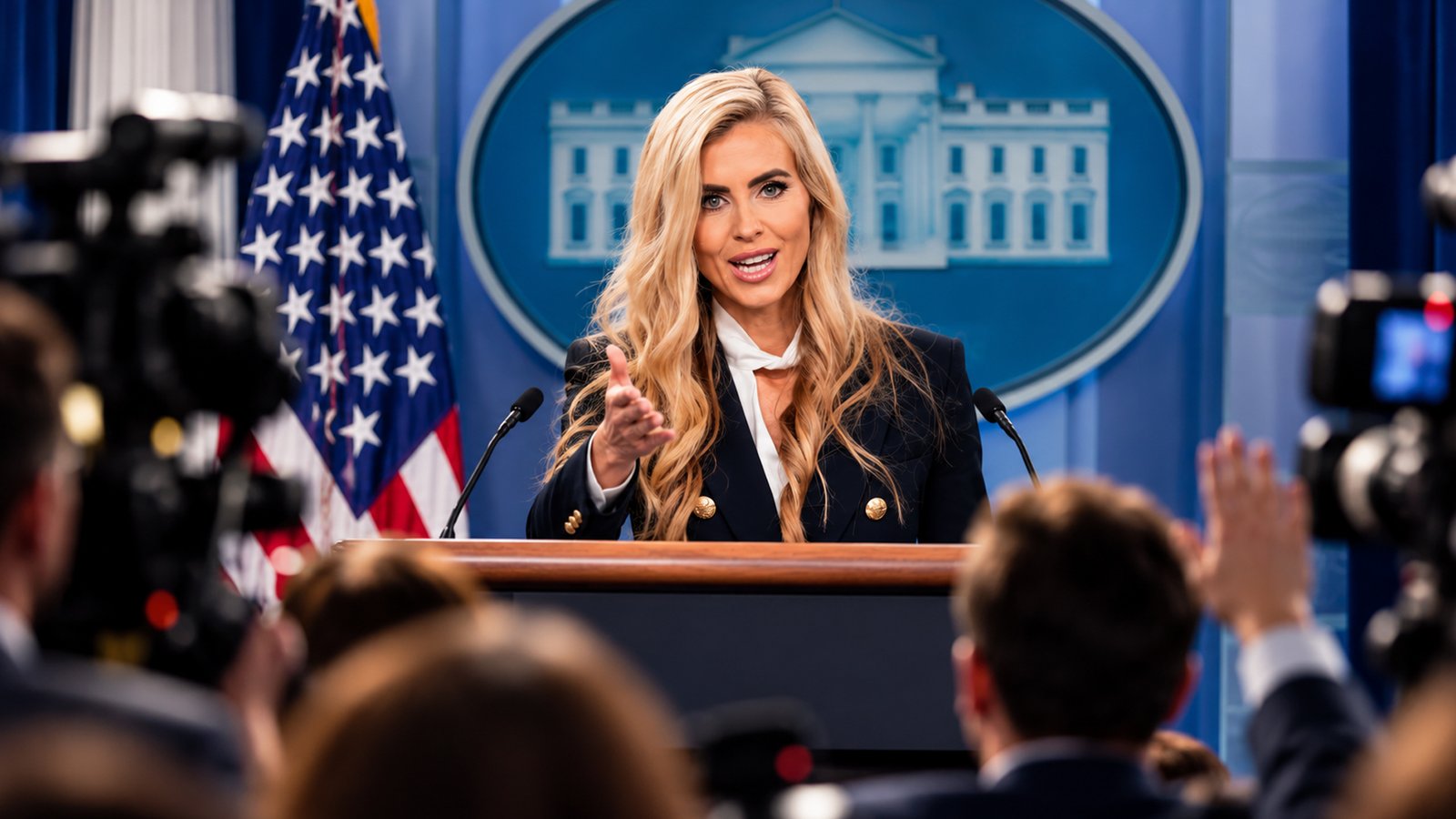
Katie Zacharia’s first appearance as White House press secretary has put her under intense scrutiny, with criticism of her briefing performance quickly followed by questions about her professional qualifications. Appointed by US President Donald Trump, Zacharia took the podium on October 13, but her brief interaction with reporters drew attention for reasons beyond the administration’s policy message.
The 14-minute briefing was dominated by a prepared statement praising Trump’s record, his rallies and his administration’s achievements. Zacharia took questions from only three media outlets before bringing the session to an abrupt close. Her handling of the questions, an awkward verbal slip and uncertainty surrounding her legal credentials have since become major talking points in Washington.
The White House has defended its new spokesperson, with officials describing her as qualified for the position. Trump himself said he thought her first briefing went well. However, the response from some media commentators and reported reactions among White House officials have been less favourable.
A difficult first appearance
Zacharia began by expressing her gratitude to Trump for appointing her and said she had wanted to work for him for a long time. She then read from prepared notes, highlighting what she described as the president’s accomplishments and the enthusiasm surrounding Republican rallies ahead of the November midterm elections.
The session became more challenging when reporters began asking questions. One journalist asked whether the Trump administration had stopped sharing intelligence with Ukraine. Zacharia replied that she would have to get back to the reporter, leaving the question unanswered during the briefing.
She also stumbled while answering a question about balancing her responsibilities as press secretary with family life. While explaining that her husband would help with their four children, she accidentally referred to Trump as “my president” before correcting herself to say “my husband”.
Although verbal slips are not unusual during live press briefings, the moment attracted attention because of the already cautious nature of her first appearance. Zacharia ended the session shortly afterwards, prompting criticism that she had not taken enough questions.
The briefing was not without a significant announcement. Zacharia said the White House had asked Kimberly Guilfoyle, the US ambassador to Greece, to resign. Guilfoyle, who was previously engaged to Trump’s son Donald Trump Jr., had faced scrutiny over allegations involving a request for financial assistance from a Republican donor.
Questions over her legal qualifications
The criticism of Zacharia’s debut was soon accompanied by questions about her claim to be a lawyer. Trump described her as an attorney when announcing her appointment, and her professional profiles have referred to her legal experience.
Zacharia holds a law degree from Pepperdine University, which confirmed that she graduated from its law school in 2011. Her professional profile also lists work with Zhong Lun Law Firm in Beijing between 2011 and 2013, followed by a role as general counsel at Fix California, a conservative advocacy organisation, from 2024 to 2025.
However, media investigations have found no public record showing that she was admitted to practise law in any US state or the District of Columbia. The State Bar of California has also said it has no record of her being licensed in that state, either under her current name or her maiden name, Kate Sharon Black.
The distinction matters because earning a law degree does not automatically grant someone a licence to practise law. In the United States, admission to a state bar is generally required to practise as a licensed attorney.
When asked where she had passed the bar examination, Zacharia reportedly replied that it was when she moved to China. Her answer raised further questions because foreign nationals cannot ordinarily practise Chinese law in Chinese courts.
Zacharia has maintained that she practised international transactional law with the appropriate credentials. The White House has similarly said that she worked on international transaction law after moving to China with her husband. However, it has not publicly provided evidence of her admission to a US state bar.
The questions do not, by themselves, establish that Zacharia misrepresented her qualifications or committed any offence. They do, however, leave aspects of her professional background unresolved.
From communications adviser to Trump’s spokesperson
Before joining the White House, Zacharia worked in communications for Trump Media and Technology Group, the company associated with the president’s Truth Social platform. She has also appeared on conservative television networks, including Fox News, defending Trump and his policies.
Her appointment came after Karoline Leavitt left the press secretary role in August. Leavitt had developed a close working relationship with Trump and became one of the administration’s most recognisable public representatives.
Zacharia now faces the task of defending the administration’s policies while responding to questions from a White House press corps that regularly challenges the president’s statements and decisions. The role demands more than delivering prepared remarks: it requires detailed policy knowledge, quick responses and the ability to manage difficult exchanges.
Her first briefing has raised questions about how quickly she can adapt to those demands. With the US midterm elections approaching, the pressure on the White House communications team is likely to increase.