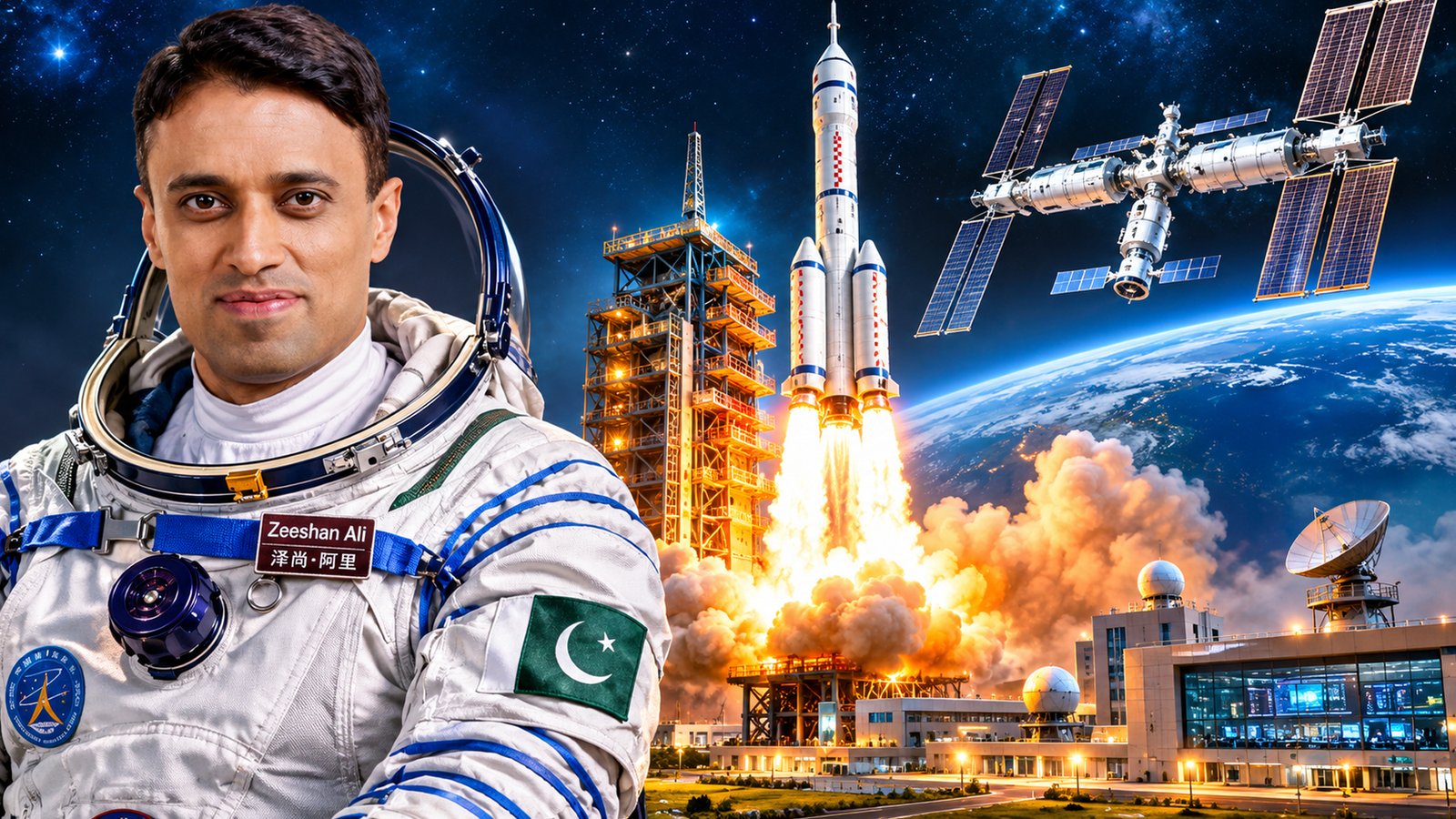
China has made history by sending the first foreign astronaut to its Tiangong space station, with Pakistani astronaut Muhammad Zeeshan Ali joining two Chinese crew members aboard the Shenzhou-24 spacecraft. The mission marks a significant milestone in China’s space programme and deepens its growing scientific partnership with Pakistan.
The spacecraft lifted off from the Jiuquan Satellite Launch Centre in northwest China on November 25, carrying a three-member crew. A Long March-2F rocket launched the spacecraft at 8.18 am local time. The crew subsequently reached the Tiangong space station, where they entered the orbital laboratory at around 2.35 pm.
Ali’s journey makes him the first Pakistani national to travel into space and the first foreign astronaut to join a crewed mission to China’s independently operated space station. The mission also marks the first time China has included an international astronaut in its human spaceflight programme.
The 40-year-old Pakistani Air Force pilot is travelling alongside Chinese astronauts Tang Hongbo and Wu Yi. Tang commands the mission, Wu serves as the flight engineer, while Ali takes on the role of payload specialist.
The successful launch and docking represent an important step in China’s efforts to position Tiangong as an international platform for scientific research and space cooperation.
Seven months of training for historic mission
Ali’s selection followed a joint astronaut programme between China and Pakistan. The two countries signed a space cooperation agreement in February 2025, under which Pakistan would nominate candidates for training in China and eventually send one astronaut to the Tiangong space station.
Pakistan’s Space and Upper Atmosphere Research Commission (SUPARCO) selected two candidates, Muhammad Zeeshan Ali and Khurram Daud, in April 2026. Both underwent training in China before authorities selected Ali for the Shenzhou-24 mission.
Ali spent seven months preparing for the flight at the Astronaut Centre of China in Beijing. His training covered spacecraft operations, emergency procedures, physical conditioning and scientific experiments. He also attended intensive Chinese-language classes to communicate effectively with his fellow astronauts.
His preparation extended beyond technical training. He learnt Chinese songs, read poetry, practised calligraphy and played table tennis as part of his efforts to understand Chinese language and culture.
Speaking ahead of the launch, Ali described the mission as a responsibility that went beyond personal achievement. He said he was carrying the hopes of millions of Pakistanis and wanted the flight to encourage young people to pursue careers in science and technology.
More than 90 scientific experiments planned
The Shenzhou-24 crew will undertake more than 90 scientific experiments and technology tests during the mission. The research will cover space science, life sciences, equipment testing and the effects of microgravity on biological materials.
Ali will contribute to experiments involving cyanobacteria, microscopic organisms that use photosynthesis to produce oxygen. Scientists are studying their potential as a source of food and oxygen for future long-duration space missions.
He will also participate in research involving quinoa seeds to understand how space conditions affect plant growth and biological processes. Such experiments could help scientists develop sustainable food production systems for astronauts travelling on extended missions.
The research has significance beyond the immediate mission. As China prepares for future crewed lunar exploration and more ambitious space projects, understanding how living organisms respond to the space environment will become increasingly important.
China’s space agency has also outlined routine maintenance, scientific research and an orbital crew rotation as key objectives of the mission.
Tiangong strengthens China’s space ambitions
The Tiangong space station, whose name translates to ‘Heavenly Palace’, has become a central part of China’s independent human spaceflight programme. The country completed construction of the three-module station in 2022 and has since maintained regular crew rotations.
Unlike the International Space Station (ISS), which operates through a partnership involving several countries, Tiangong remains under Chinese control. However, Beijing has increasingly presented the facility as a platform for international scientific cooperation.
China’s decision to include a Pakistani astronaut reflects this approach. The mission also comes at a time when the future of the ISS is under discussion, with current plans pointing towards its retirement around 2030.
Beijing has invested heavily in its space programme and aims to send astronauts to the Moon before 2030. It is also developing technologies for future deep-space exploration, including potential missions to Mars.
China’s growing cooperation with Pakistan could help expand its international partnerships in these areas.
China-Pakistan space partnership enters new phase
The Shenzhou-24 mission represents a major development in the longstanding strategic relationship between China and Pakistan. Their space cooperation dates back several decades, with Beijing supporting Pakistan’s satellite launches and broader space technology ambitions.
The partnership is expected to extend beyond human spaceflight. A Pakistani-built rover is also expected to participate in a Chinese lunar mission planned around 2028, creating further opportunities for joint scientific research.
Pakistani leaders have welcomed Ali’s journey as a landmark achievement for the country’s space programme. Prime Minister Shehbaz Sharif described the mission as a proud moment and highlighted the growing friendship between the two countries.
For Pakistan, the mission offers an opportunity to develop expertise in human spaceflight, astronaut training and scientific research. It could also encourage greater investment in science, technology, engineering and mathematics education.
Ali has expressed hope that the partnership will move beyond a single astronaut and one mission. He wants future cooperation to include more joint flights and eventually extend to lunar and Martian exploration.
With Shenzhou-24 now at Tiangong, the mission has opened a new chapter in China’s international space programme. More importantly, it has given Pakistan its first astronaut in orbit and created a pathway for deeper participation in future human spaceflight missions.