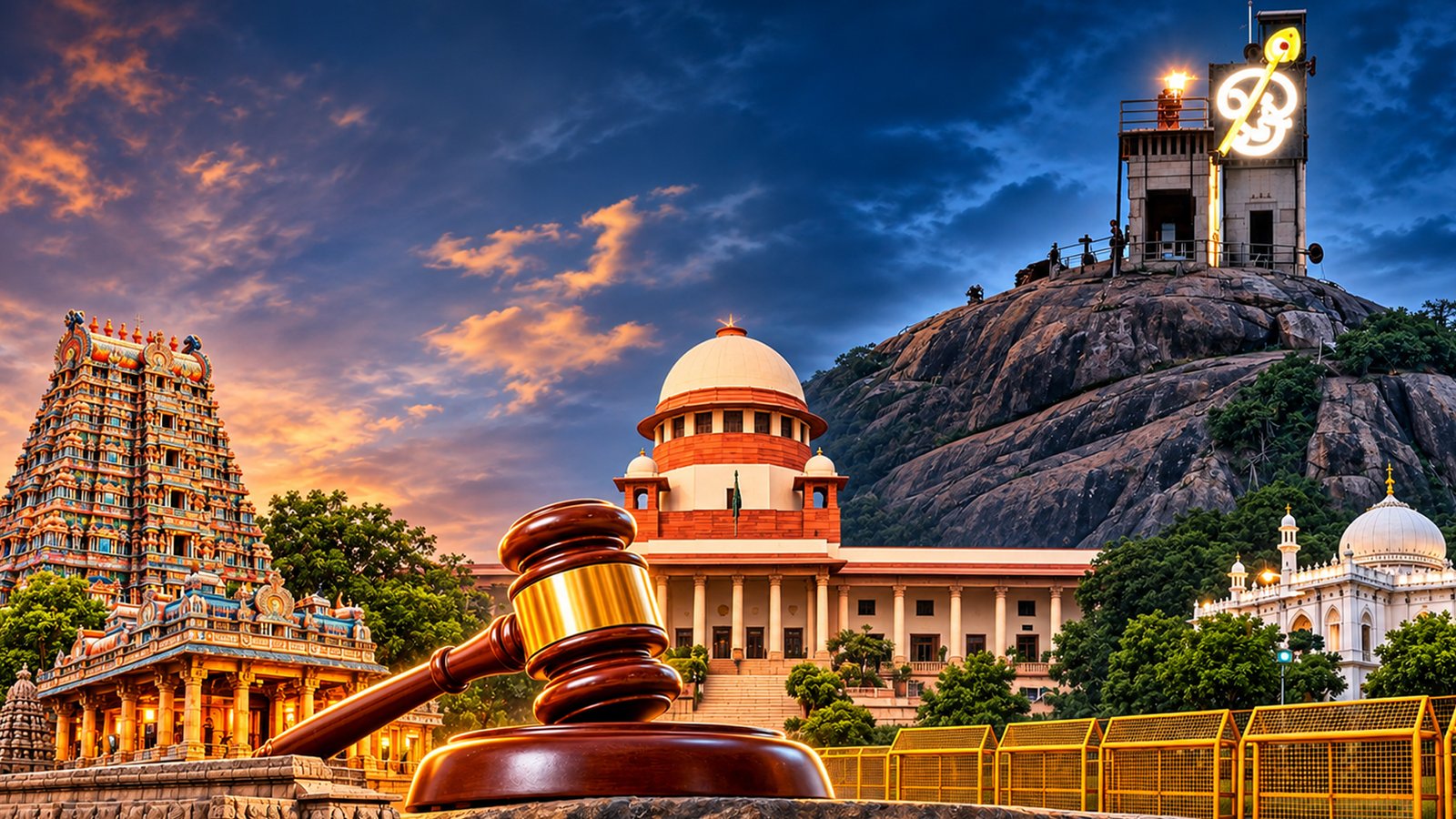
The annual Karthigai Deepam celebrations at Thiruparankundram hill in Madurai, Tamil Nadu, have turned into a major legal and political controversy after the state government failed to light the Maha Deepam at a disputed stone pillar, despite a Supreme Court directive. The ceremonial lamp was instead lit at the temple’s customary location on November 24, triggering protests and accusations of judicial non-compliance.
The controversy centres on Deepathoon, a stone pillar situated on Thiruparankundram hill, around 50 metres from the Sikandar Badusha Dargah. Hindu organisations and devotees have argued that the pillar is the traditional location for lighting the Karthigai Deepam. However, the temple administration and the Tamil Nadu government have maintained that the customary ritual takes place at the Deepa Mandapam near the Uchi Pillaiyar Temple.
The dispute has been ongoing since 2025, when the temple administration refused to permit the lighting of the ceremonial lamp at Deepathoon. The issue subsequently reached the Madras High Court, which directed the authorities to allow the ritual at the disputed location. A division bench upheld the direction in January 2026, leading the state government to approach the Supreme Court.
Supreme Court allows one-time lamp lighting
On November 20, the Supreme Court permitted the lighting of the Karthigai Deepam at Deepathoon on November 24 as a one-time arrangement. A bench comprising Justices Aravind Kumar and Vipul M Pancholi issued the direction while hearing the Tamil Nadu government’s challenge to the Madras High Court proceedings.
The court directed that only a small, authorised team from the temple administration and government officials could access the pillar to perform the ritual. It asked the Madurai District Collector to finalise the team’s composition in consultation with the temple executive officer, the Archaeological Survey of India (ASI) and the Madurai Police Commissioner.
The court also appointed the Collector as the nodal officer to coordinate the arrangements and submit a compliance report within three days of the festival.
Importantly, the Supreme Court clarified that its permission did not establish any permanent customary right to light the lamp at Deepathoon. The one-time arrangement would not determine whether the pillar was historically used for religious worship or whether devotees had an enforceable right to perform the ritual there.
The court also directed that the ceremony should not interfere with the functioning of the Dargah and mosque on the hill. It prohibited public gatherings, processions and demonstrations at the site during the ritual.
Tamil Nadu lights lamp at customary location
Despite the Supreme Court’s direction, the Maha Deepam was lit at around 6 pm on November 24 at the Deepa Mandapam near the Uchi Pillaiyar Temple. The disputed Deepathoon remained unlit.
The decision came even as the Tamil Nadu government informed the Madras High Court earlier that day that it was making arrangements to implement the Supreme Court’s order. The High Court had also reminded the district administration that the pendency of the state’s review petition did not excuse non-compliance with the apex court’s directive.
The Madras High Court directed officials to ensure that the Supreme Court’s order was implemented and that restrictions imposed by the district administration did not obstruct devotees’ religious rights.
However, the temple’s Board of Trustees reportedly decided to follow the established religious practices and light the lamp only at the customary location. The trustees maintained that Deepathoon was not the traditional site for the ceremony and that the ritual should follow the temple’s established customs and Agama traditions.
The temple administration’s position became a key factor in the district administration’s inability to carry out the Supreme Court’s direction.
Collector apologises to Supreme Court
The controversy took a fresh turn on November 25 when Madurai District Collector Nishant Krishna submitted a status report to the Supreme Court and apologised for the failure to light the lamp at Deepathoon.
Representing the Collector, senior advocate Gopal Sankaranarayanan informed the bench that the district administration had made several attempts to secure the temple administration’s approval for the ceremony. However, the temple’s Board of Trustees did not authorise the proposed team to perform the ritual at the disputed pillar.
According to the Collector’s report, he held meetings with temple officials on November 21 and 22 and followed them up with official letters, emails and reminders. He also sought the intervention of the Hindu Religious and Charitable Endowments (HR&CE) Department.
The report stated that the temple trustees had instead resolved to conduct the ceremony at its customary location. The Collector maintained that he could not independently appoint a team or override the temple administration’s decision, as the Supreme Court had specifically required the team to be authorised by the Devasthanam.
He denied deliberately disobeying the court’s direction and expressed regret over the failure to implement it.
The Supreme Court said it would consider a contempt petition if the petitioners formally filed one. The petitioners indicated their intention to approach the court over the alleged non-compliance.
Political tensions and protests
The failure to light the lamp at Deepathoon triggered protests by BJP leaders and Hindu organisations, who accused the state government of disregarding the Supreme Court’s order. Police had deployed additional personnel around the hill to prevent tensions and maintain law and order.
The dispute has also become a political flashpoint for the Vijay-led Tamil Nadu government. Opposition leaders have questioned the administration’s handling of the issue, while the government has cited the temple administration’s refusal to authorise the ceremony as the reason for the non-compliance.
The controversy has brought religious traditions, access to places of worship and the authority of judicial orders into sharp focus.
The Supreme Court is yet to settle the larger questions surrounding the historical status of Deepathoon, the customary location of the Karthigai Deepam and the competing claims concerning religious rights on the hill.