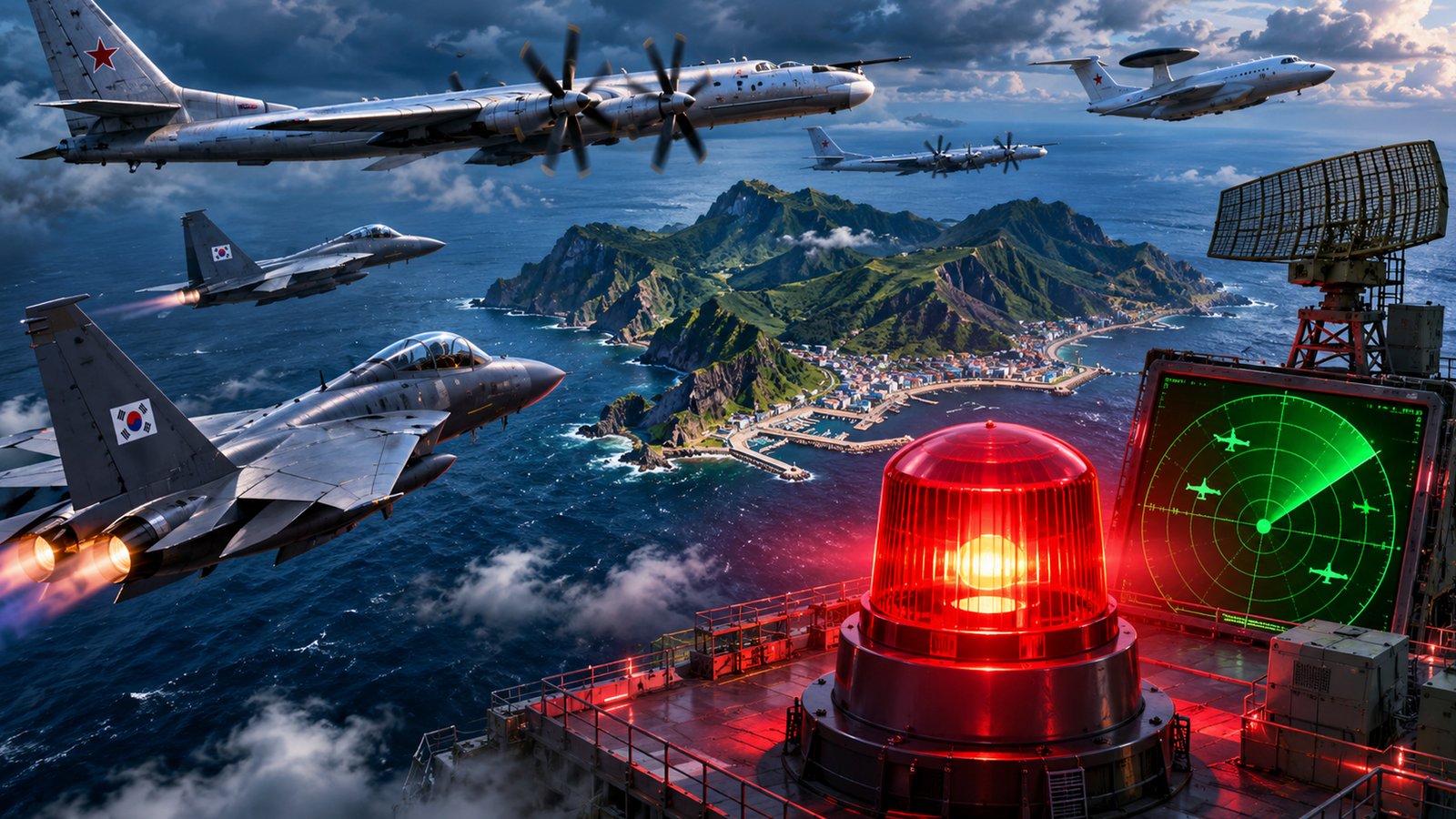
South Korea scrambled fighter jets and briefly issued an emergency shelter warning on Tuesday, November 24, after several Russian military aircraft entered its air defence identification zone (KADIZ) near the country’s eastern coast. The aircraft flew close to South Korean airspace, raising concerns about a possible intrusion. However, they left the area without violating the country’s territorial airspace, the military confirmed.
The incident triggered confusion among residents of Ulleung Island after authorities issued an air raid warning asking people to move to underground shelters. Officials withdrew the warning within three minutes after the Russian aircraft moved away from the area.
According to South Korea’s Joint Chiefs of Staff (JCS), around five Russian military aircraft entered the Korea Air Defence Identification Zone over the East Sea early Tuesday. The aircraft approached Ulleung Island, located around 130 km east of the Korean Peninsula.
South Korean military officials said the Russian aircraft came dangerously close to the country’s territorial airspace. The military feared that the situation could develop into an actual airspace violation. It therefore deployed fighter jets as a precaution.
South Korea’s Air Force scrambled F-15K fighter jets to monitor the Russian aircraft and prevent any possible incident. The fighter jets carried out tactical manoeuvres as the Russian planes approached the island. The Russian aircraft eventually turned towards Japan and left the zone before flying north. Their entry into the air defence identification zone lasted around 20 minutes.
JCS spokesperson Captain Jang Do-young said the military issued the warning in advance because it anticipated a possible intrusion. He said the authorities wanted to protect residents and ensure public safety.
The military also clarified that reports suggesting Russian aircraft had entered South Korean sovereign airspace were incorrect. The aircraft entered the country’s air defence identification zone but did not cross into its territorial airspace.
The incident also exposed communication problems between South Korean authorities during the emergency.
At around 7.52 am, the Ministry of the Interior and Safety sent an emergency message to Ulleung Island residents. It warned that Russian aircraft had entered South Korean airspace and asked people to evacuate to underground facilities or buildings.
Authorities withdrew the warning three minutes later after the aircraft left the area.
However, another message from the North Gyeongsang provincial government created further confusion. The message incorrectly identified the approaching aircraft as suspected North Korean military planes. Officials later corrected the information and confirmed that the aircraft belonged to Russia.
The mistaken reference to North Korean aircraft raised additional concerns because North and South Korea remain technically at war. Any suggestion of a North Korean military intrusion could have heightened tensions on the Korean Peninsula.
The South Korean military said it would examine the circumstances surrounding the incorrect emergency messages. Military spokesperson Jang also said officials needed to investigate the communication process between the military and government agencies.
The warning was unusual because South Korea has dealt with Russian aircraft entering its air defence identification zone several times in recent months. However, authorities rarely issue public evacuation alerts in response to such flights.
South Korea’s Defence Ministry said it would summon a military attaché from the Russian Embassy in Seoul to lodge a formal protest over the incident.
The ministry wants Moscow to prevent similar military aircraft movements in the future. Russia’s embassy had not immediately issued a public response to the incident.
The latest episode comes amid repeated encounters involving Russian military aircraft near South Korea and other countries in the region.
South Korean officials said Russian aircraft had entered the country’s air defence identification zone on November 17 as well. The planes left the area without violating South Korean territorial airspace.
Similar incidents have occurred earlier this year. In August, Russian military aircraft entered the same zone. In June, nearly 10 Chinese and Russian military aircraft flew into and out of the zone over South Korea’s eastern and southern waters during what appeared to be joint military exercises.
Seoul protested against the June movements through diplomatic channels and raised concerns with both countries.
The region has also witnessed tensions involving military aircraft from Russia, China, Japan and South Korea. These movements have increased security concerns in the East Sea, also known as the Sea of Japan.
An air defence identification zone is an area that extends beyond a country’s territorial airspace. Countries establish these zones to identify, track and monitor foreign aircraft approaching their airspace.
Military aircraft entering such zones may have to identify themselves and follow certain procedures. However, entering an air defence identification zone does not automatically amount to violating a country’s sovereign airspace.
South Korea’s territorial airspace covers the country’s land and territorial waters. Its KADIZ extends beyond these boundaries and serves as an early warning area against potential security threats.
Russia and China do not recognise South Korea’s authority over the KADIZ. Both countries have questioned the legal basis for such zones under international law.
The distinction between an air defence identification zone and sovereign airspace is important in Tuesday’s incident. Although Russian aircraft entered the KADIZ, South Korea confirmed that they did not cross its territorial boundaries.
The incident also brings back memories of a more serious confrontation in July 2019. A Russian A-50 early warning aircraft entered South Korea’s air defence zone near the disputed Dokdo islands and violated its airspace twice. South Korean fighter jets scrambled in response and fired warning shots.