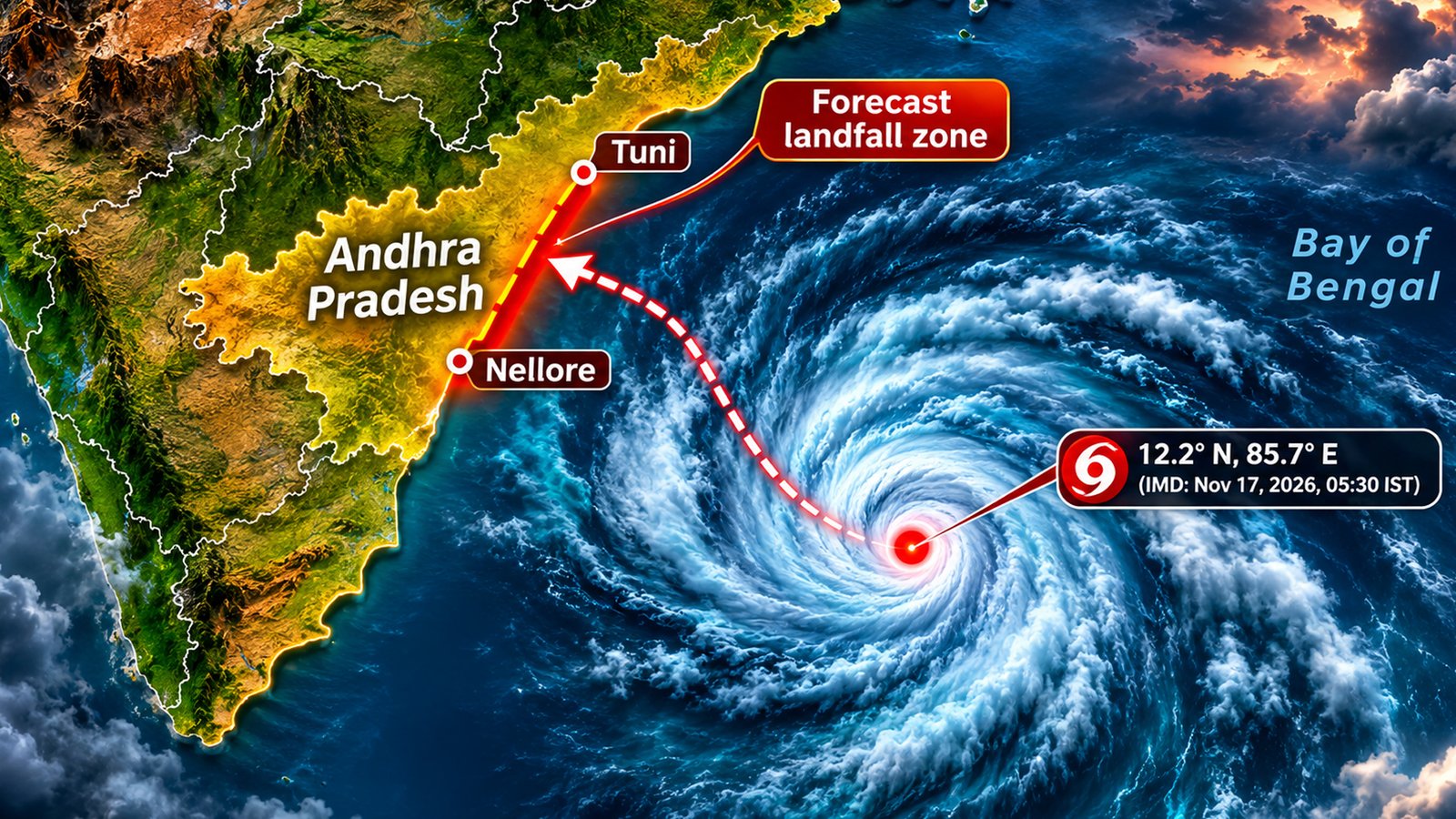
The Bay of Bengal is witnessing an intensifying weather system as Cyclone Akvan moves towards India’s eastern coastline, prompting authorities in Andhra Pradesh and Odisha to step up preparations. The India Meteorological Department (IMD) has warned that the cyclone is likely to strengthen into a very severe cyclonic storm before crossing the Andhra Pradesh coast on November 20, bringing strong winds, heavy rainfall and rough sea conditions.
According to the IMD’s latest bulletin issued on November 17, the cyclonic storm was positioned over the central parts of the south and adjoining west-central Bay of Bengal. At 5.30 am, the system was located near latitude 12.2°N and longitude 85.7°E. It was approximately 610 km east of Chennai, 660 km southeast of Machilipatnam and 670 km south-southeast of Visakhapatnam.
The weather system has been moving in a north-northwestward direction. Meteorologists expect it to continue along this path while gaining strength over the Bay of Bengal. The IMD has forecast that Cyclone Akvan could intensify into a severe cyclonic storm by the evening of November 17 and further strengthen into a very severe cyclonic storm by the morning of November 19.
The projected movement and increasing intensity have placed coastal Andhra Pradesh on alert, with neighbouring Odisha, Tamil Nadu and Telangana also expected to experience the effects of the system.
Andhra Pradesh faces possible cyclone landfall
The IMD has indicated that Cyclone Akvan is likely to cross the Andhra Pradesh and Yanam coasts between Nellore and Tuni around noon on November 20. At the time of landfall, the cyclone is expected to generate maximum sustained wind speeds of 120-130 kmph, with gusts reaching up to 145 kmph.
Winds of this intensity can damage houses, uproot trees, disrupt electricity supply and affect communication networks. Coastal areas could experience dangerous sea conditions, while heavy rainfall may lead to flooding in low-lying locations.
The IMD has issued alerts for coastal districts and advised residents to remain cautious as the cyclone approaches. Authorities are closely monitoring the storm’s movement and preparing emergency response arrangements to minimise potential damage.
Heavy rainfall forecast in Andhra, Tamil Nadu and Odisha
Heavy rainfall is expected across several parts of southern and eastern India as Cyclone Akvan moves closer to the coast. The IMD has forecast heavy to very heavy rainfall at a few places, with isolated extremely heavy rainfall, over coastal Andhra Pradesh and Yanam on November 19 and 20.
Districts along the northern Andhra Pradesh coastline are likely to face particularly challenging conditions. Konaseema, Kakinada, East Godavari, West Godavari, Krishna, NTR and Guntur are among the areas that could receive substantial rainfall.
Telangana is also expected to experience heavy rainfall on November 20 and 21. The downpour could affect road connectivity, disrupt normal activities and cause waterlogging in vulnerable locations.
In Tamil Nadu, Chennai, Tiruvallur and Chengalpattu are among the districts likely to receive rainfall. Other areas, including Kanchipuram, Ranipet, Tiruvannamalai, Villupuram and Cuddalore, are also expected to experience heavy showers. Puducherry and Karaikal could receive heavy to very heavy rainfall on November 18 and 19.
Parts of Odisha are also likely to experience intense rainfall. Ganjam, Gajapati and Puri are among the districts under close watch, while Malkangiri, Koraput and Rayagada could also experience adverse weather conditions.
Odisha steps up disaster preparedness
The Odisha government has intensified its preparations, deploying 74 rescue teams to respond to possible emergencies. The deployment includes 60 Odisha Disaster Rapid Action Force (ODRAF) teams and 14 National Disaster Response Force (NDRF) teams.
Authorities have started precautionary evacuation measures in vulnerable southern districts and directed district administrations to remain prepared for emergencies. Arrangements are also being made to ensure that rescue teams, essential supplies and emergency services are available wherever required.
Revenue and Disaster Management Minister Suresh Pujari said the government was taking steps to safeguard lives and property. Officials are monitoring rainfall projections and identifying areas that could face flooding or other cyclone-related damage.
Andhra government directs officials to remain prepared
In Andhra Pradesh, Chief Minister N Chandrababu Naidu has instructed officials to strengthen preparedness across vulnerable districts. He has directed authorities to position NDRF and State Disaster Response Force (SDRF) teams at strategic locations so that rescue and relief operations can begin without delay.
The electricity department has been asked to stock essential equipment, including transformers, electric poles and conductors, to ensure quick restoration of power in cyclone-affected areas.
Special attention is also being given to agriculture. Farmers have been advised to harvest mature crops wherever possible and clear drainage channels to prevent waterlogging. Officials are assessing the possible impact of heavy rainfall on standing crops and agricultural infrastructure.
Fishermen have been advised not to venture into the sea as conditions are expected to deteriorate. Authorities are also monitoring fishing vessels and communicating weather warnings to coastal communities.
Coastal communities advised to remain alert
The approaching cyclone is expected to make sea conditions increasingly dangerous along the Andhra Pradesh coast. Residents in vulnerable coastal areas have been advised to follow official instructions, avoid unnecessary travel and move to safer locations if directed by authorities.
The IMD and disaster management agencies are continuing to track the cyclone’s movement and intensity. Changes in its direction, speed and strength over the coming days will be important in determining the extent of its impact.
With Cyclone Akvan expected to intensify before its projected November 20 landfall, preparedness across Andhra Pradesh and neighbouring states remains critical. Authorities are focusing on timely evacuation, emergency response and the protection of vulnerable communities as the region braces for potentially severe weather.