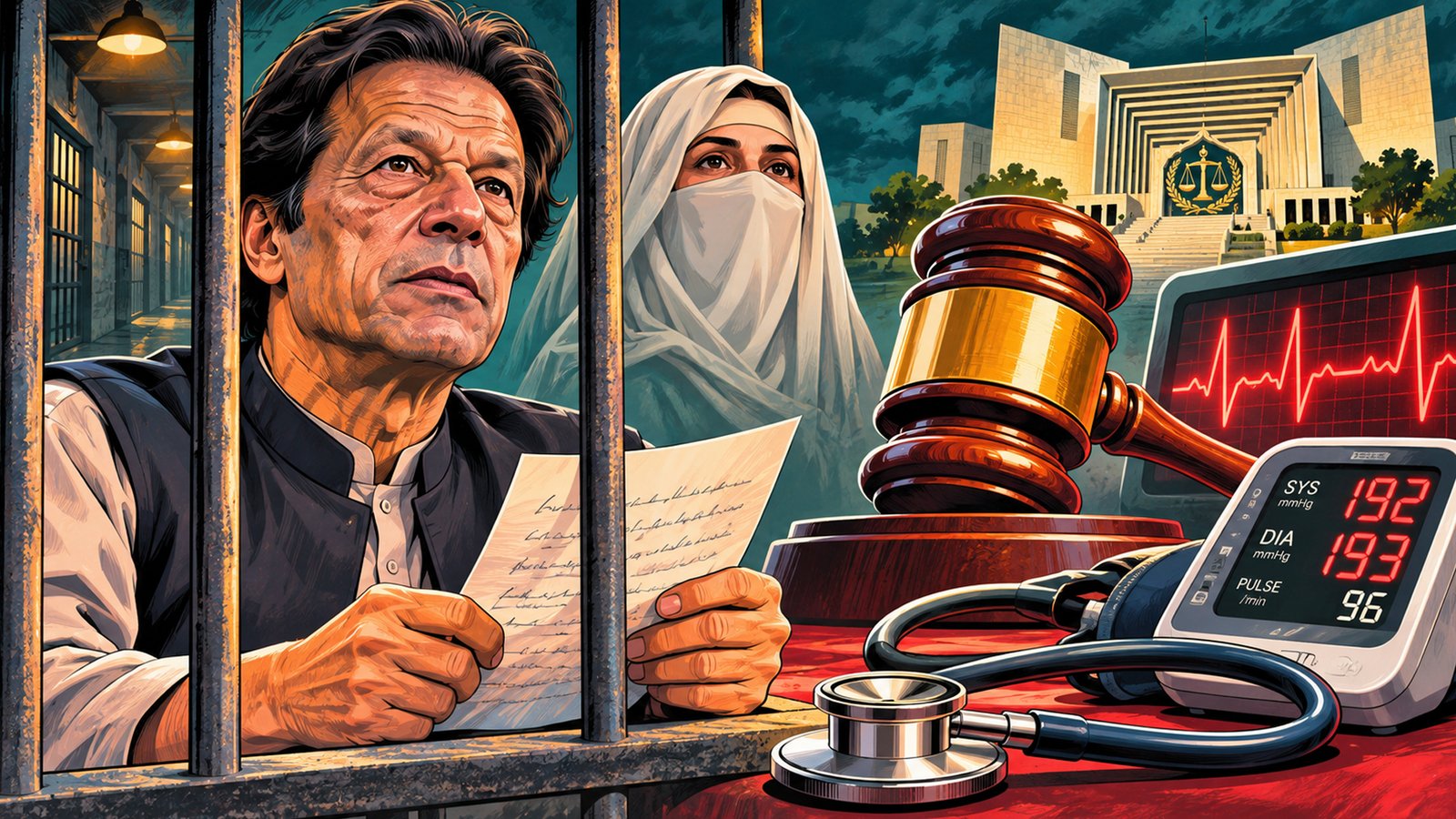
Pakistan’s jailed former prime minister Imran Khan has made an urgent appeal to the country’s top judges, warning that his deteriorating health could put his life at risk if he does not receive proper medical attention. In an open letter, the 74-year-old former cricketer said he feared he might not return alive from prison and urged the judiciary to intervene before it was too late.
Khan’s appeal, dated November 16, was addressed to the chief justices of Pakistan’s Supreme Court, Federal Constitutional Court and Islamabad High Court. He sought immediate medical treatment for himself and his wife, Bushra Bibi, who is also serving a prison sentence.
The letter was made public by his lawyer, Barrister Salman Safdar, on social media platform X. Safdar said he had prepared it based on instructions and notes provided by Khan during a nearly three-hour meeting at Adiala Jail in Rawalpindi on November 11.
The appeal has brought renewed attention to the health of Pakistan’s imprisoned opposition leader, his treatment in custody and the continuing political and legal tensions surrounding his incarceration.
In the letter, Khan described his health as increasingly fragile and alleged that prolonged isolation inside the prison had worsened his medical condition. He claimed his blood pressure had risen sharply in recent weeks, reaching readings of 192 and 193 on November 10.
According to Khan, doctors had warned him that he faced a serious risk of a brain haemorrhage or cardiac arrest. He also claimed that his heart had already suffered damage and that his condition required proper medical supervision.
“At seventy-four, this unrelenting state is taking me to a place from which I may not return alive,” he wrote, appealing to the judges to ensure that his medical needs were addressed.
Khan also raised concerns about his eyesight, saying he had lost around 85 per cent of the vision in his right eye. He alleged that the extent of the problem had not been communicated to his family or legal representatives when it was first identified.
His lawyer had reportedly noticed the severe vision loss during a meeting in February, after being appointed by the Supreme Court to examine Khan’s circumstances as an amicus curiae, or friend of the court.
The former prime minister said he had been kept in solitary confinement for up to 22 hours a day since December 20, 2025. He alleged that restrictions on contact with the outside world had left him without regular access to family members, lawyers and even basic comforts such as books and television.
Khan also complained that he had been allowed to meet his legal counsel only four times during the year. He said the restrictions had affected his ability to prepare his defence in the cases against him.
He maintained that he was not seeking special privileges because of his former position as Pakistan’s prime minister. Instead, he wanted the authorities to respect prison regulations, constitutional protections and existing judicial directions.
A major part of Khan’s appeal concerns an earlier Supreme Court order dated August 18. According to the former prime minister, the court had directed prison authorities to transfer him to Shifa International Hospital in Islamabad within two days for an examination by a specialised medical board. He alleged that the direction was not properly implemented.
Instead, Khan was taken to the government-run Pakistan Institute of Medical Sciences (PIMS) in Islamabad and returned to prison within hours, according to his account.
His health concerns have come into focus again following a hospital visit on the night of November 10. He was taken from Adiala Jail to PIMS for an eye examination and further treatment. The hospital said the visit was arranged on the advice of the ophthalmologist treating him. He reportedly received another injection in his right eye.
The treatment is linked to central retinal vein occlusion, a condition affecting blood flow in the retina that can cause serious vision problems. Khan had previously received injections as part of his treatment.
However, his latest letter suggests that he remains concerned about the adequacy of the medical facilities available to him in prison.
Khan has also urged the judiciary to address the medical condition of his wife, Bushra Bibi, who is imprisoned alongside him on corruption charges.
In the letter, he alleged that Bushra Bibi suffered a retinal detachment in April and underwent complicated eye surgery. He warned that she could permanently lose her eyesight without further treatment.
He also claimed that her medical records had not been made available and that access to appropriate medical specialists had been restricted.
Bushra Bibi’s legal team has separately approached the Islamabad High Court, seeking access to her complete medical records and her immediate transfer to a specialised hospital for treatment.
The concerns have added another dimension to the couple’s legal battle, with both seeking medical intervention while serving their sentences.
The Pakistani government has disputed Khan’s claims about inadequate healthcare and prison conditions. Parliamentary Affairs Minister Tariq Fazal Chaudhry said the former prime minister had been taken to PIMS eight times for medical examinations and that doctors had found his health and blood pressure readings satisfactory.