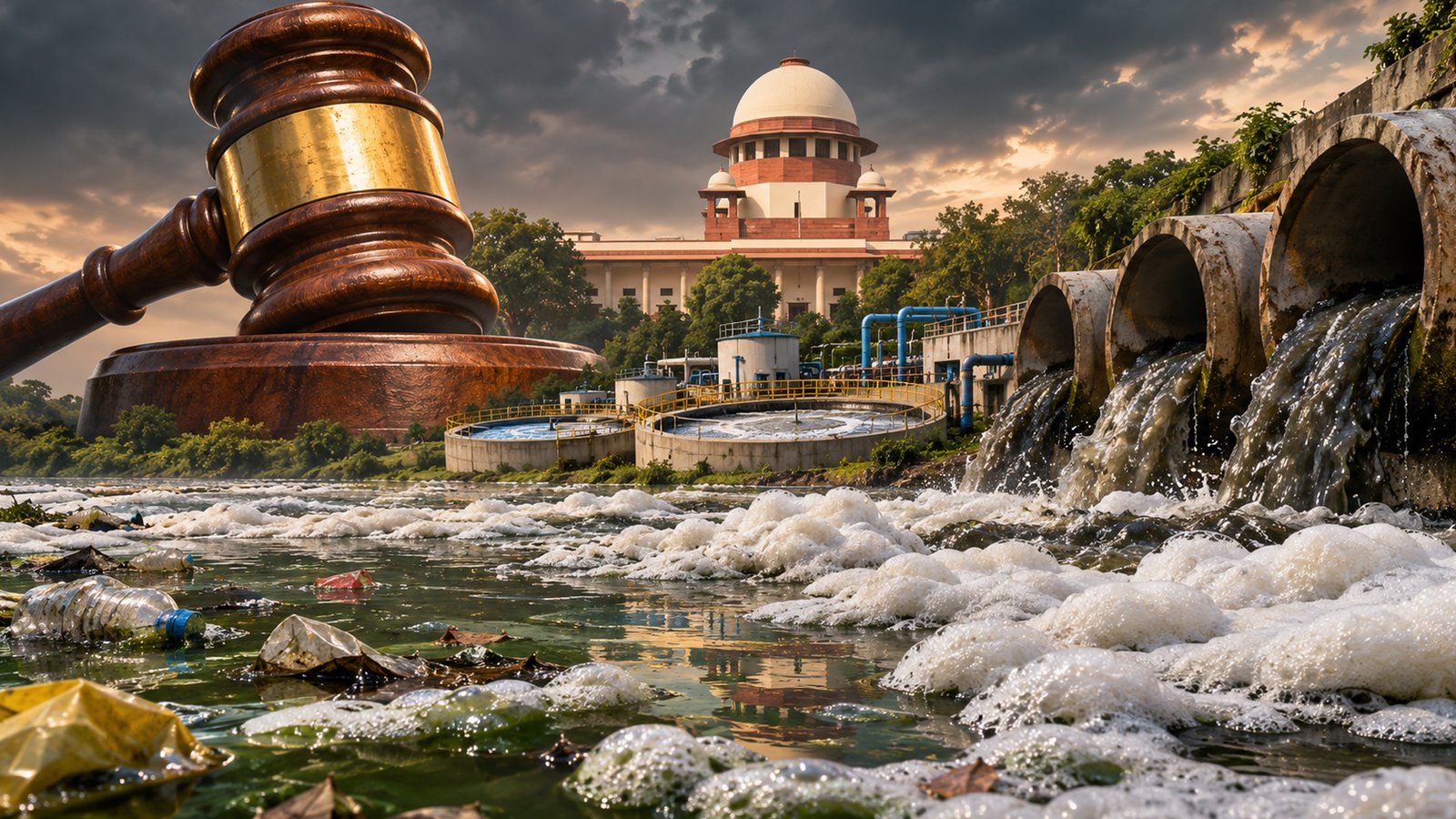
The Supreme Court has expressed serious concern over the worsening condition of the Yamuna, observing that pollution in the river has continued to increase despite huge amounts of public money being spent on cleaning and restoration projects. The court has blamed poor civic administration, untreated sewage, industrial waste and lack of coordination among government agencies for the river’s deteriorating condition.
In an order dated November 4, a Bench of Justices Manoj Misra and Manmohan said the condition of the Yamuna reflected the administrative failures of towns, cities and villages located along its banks. It pointed out that as many as 520 drains discharge wastewater into the river, making pollution control a major challenge.
The court directed the Central Pollution Control Board (CPCB) to closely monitor water quality at points where the Yamuna and its major drains enter and exit different states, Union territories and districts. The move is aimed at identifying the sources of pollution and fixing responsibility on authorities overseeing the river’s different stretches.
The Bench stressed that industrial pollutants and untreated sewage must be stopped at their source. Where preventing direct discharge is not immediately possible, sewage must be intercepted and treated before entering the river. It also cautioned that simply constructing more sewage treatment plants (STPs) would not solve the problem unless existing infrastructure was properly maintained and operated.
The court highlighted the difficulties faced by civic authorities in managing wastewater from illegal and unauthorised colonies, particularly those built on encroached land. Many such settlements lack planned layouts and adequate space for laying underground sewerage networks. The mixing of sewage with stormwater drains has further complicated efforts to prevent untreated wastewater from reaching the Yamuna.
It observed that sewage from unauthorised colonies and slum clusters located along drains and the riverbed would continue to contaminate the river unless these settlements were addressed and their residents rehabilitated. The Bench underlined that rehabilitation must accompany action against encroachments.
The Supreme Court also raised concerns about the functioning of Delhi’s existing sewage treatment plants. It pointed out discrepancies between the government’s claims and the findings submitted by the CPCB.
While the Yamuna Action Plan stated that 28 of Delhi’s 37 existing sewage treatment plants met prescribed standards, the pollution control board’s assessment indicated that none met all the required parameters. Only five plants reportedly complied with the bacteriological limit.
The findings have raised questions about the effectiveness of the infrastructure created to control sewage pollution. Even when treatment facilities are available, their inability to meet prescribed standards means contaminated water can continue flowing into the river.
The court also flagged inconsistencies in the government’s assessment of encroachments on water bodies and wetlands in Delhi’s Zone ‘O’. Although the draft action plan suggested that these areas were free from encroachments, an annexure prepared by the Delhi government identified all 35 water bodies and wetlands in the zone as encroached upon.
The Bench said Zone ‘O’, identified in the Delhi Master Plan 2047, should be protected as a green zone. It called for removing unauthorised structures in accordance with the law and providing alternative accommodation to eligible occupants. Permanent construction should not be permitted in the protected area, except for green parks and essential public infrastructure.
The court also emphasised that the Yamuna should have sufficient space to flow naturally and that its floodplains must be protected from unplanned development.
The Supreme Court examined the comprehensive Yamuna Action Plan prepared by a committee headed by the Union Home Secretary. The plan identifies domestic sewage as the single largest source of pollution entering the river.
It proposes the construction of 125 new sewage treatment plants with a combined capacity of around 4,401 million litres per day across the Yamuna basin. Another 20 existing plants are proposed to be upgraded to improve their treatment capacity.
The plan also includes 12 new common effluent treatment plants, 10 municipal solid waste processing facilities and 23 biogas plants. In addition, it proposes improvements to existing industrial wastewater treatment infrastructure and the restoration of 270 water bodies, including ponds, wetlands and floodplain water bodies.
A major component involves intercepting, diverting and treating wastewater from all 520 drains that currently discharge approximately 9,666.81 million litres of wastewater daily into the Yamuna and its tributaries.
While acknowledging that the action plan represents progress, the court stressed that its success would depend on proper implementation, regular monitoring and accountability among the agencies concerned.
In a significant move, the Supreme Court has sought to establish accountability across the entire Yamuna basin rather than allowing individual states and local authorities to shift responsibility for pollution.
Invoking the principle of Common But Differentiated Responsibilities, the Bench said states and Union territories sharing the river must treat it as one continuous ecosystem. Their responsibility should depend on their contribution to pollution and their capacity to address it.
The court directed the CPCB to suggest a formula for calculating environmental compensation if water quality deteriorates while the river passes through a particular state, Union territory or district. The concerned authorities could face financial penalties, with the amount deposited in the Supreme Court Registry. States and Union territories may subsequently recover the fines from polluters and officials found responsible after an inquiry.
The CPCB has also been asked to investigate pollution incidents such as fish deaths, floating white foam, algal blooms and sudden increases in biochemical oxygen demand (BOD), chemical oxygen demand (COD) and total suspended solids (TSS). Its reports must identify the reasons behind such incidents and recommend corrective measures.
The court has further ordered surprise inspections and monitoring of sewage and industrial treatment facilities. Treatment plants must provide access to their premises, operational records and monitoring data to the CPCB and designated expert agencies. Unannounced sample collection and technical assessments will help establish whether these facilities are functioning as required.
The Bench has also directed the chief secretaries of states and Union territories through which the Yamuna flows, along with concerned central ministries, to nominate senior nodal officers to coordinate implementation.
The matter will be heard next on January 13, 2027.
The latest observations underline a larger concern surrounding river conservation in India: spending on infrastructure alone cannot restore a polluted river without effective sewage management, industrial regulation, protection of floodplains and coordination between government agencies. For the Yamuna, the challenge now is to translate years of cleanup commitments into measurable improvements in water quality.