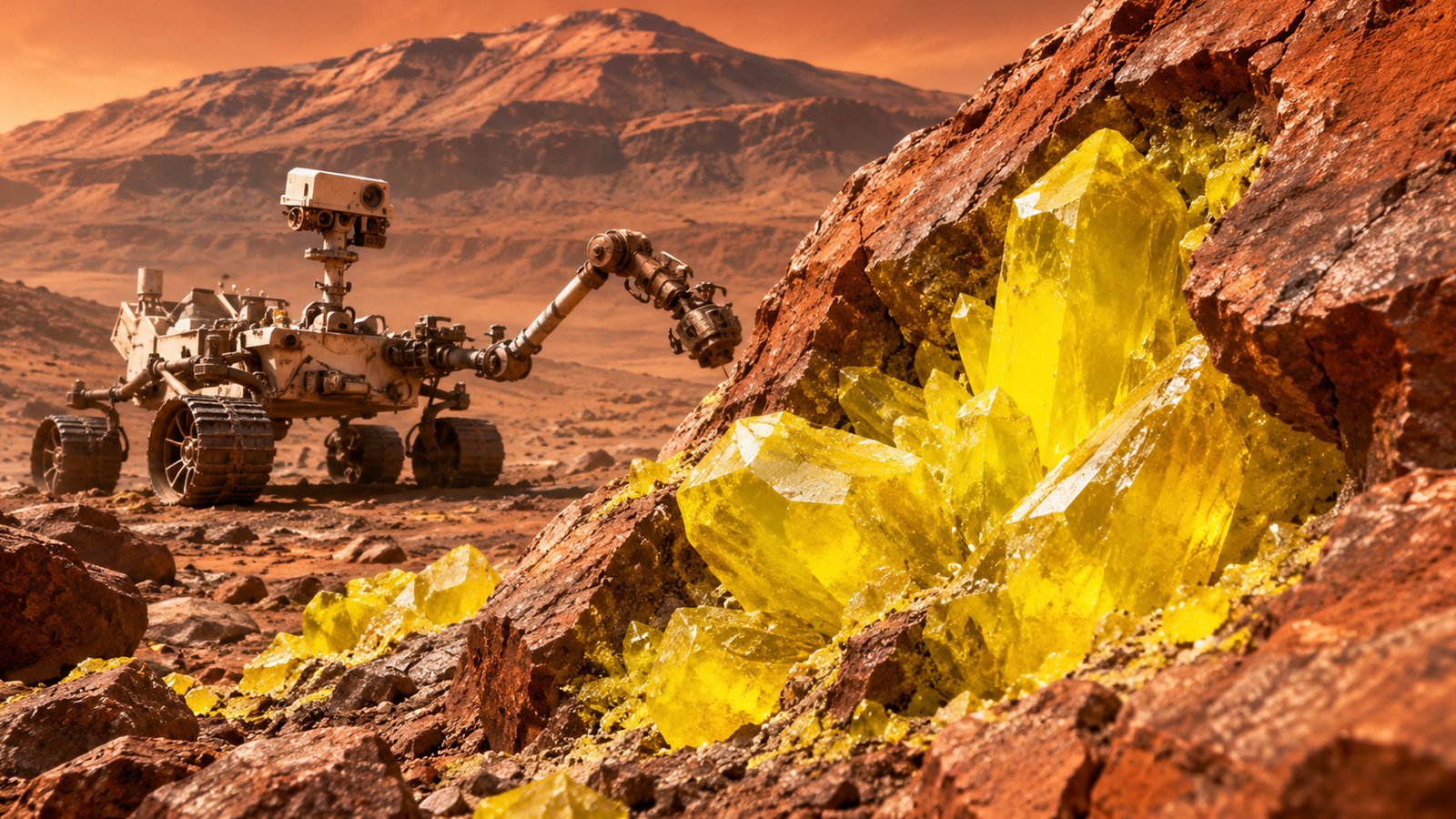
A routine journey across the rocky surface of Mars led to an extraordinary discovery when NASA’s Curiosity rover accidentally crushed an ordinary-looking rock and exposed bright yellow crystals hidden inside. What initially appeared to be an unusual geological find has now opened up fresh questions about the Red Planet’s ancient environment, with two new scientific studies offering possible explanations for the mysterious deposits.
The discovery dates back to May 30, 2024, when the 899-kg Curiosity rover was exploring the Gediz Vallis Channel in Mars’ Gale Crater. As the six-wheeled robotic explorer moved across the uneven terrain, one of its wheels rolled over a rock, breaking it open and revealing a collection of pale yellow crystals.
Scientists subsequently examined the material using an instrument attached to the rover’s robotic arm. The analysis confirmed that the crystals were made of elemental sulphur, also known as pure sulphur. This marked the first confirmed discovery of sulphur in its pure elemental form on Mars.
Although sulphur-containing minerals have been detected on the planet before, finding deposits consisting of pure sulphur was unexpected. Even more surprising was the presence of several similar rocks scattered across the surrounding landscape.
The discovery has attracted renewed scientific attention following two studies published in 2026, which examine how these unusual deposits could have formed and what they reveal about Mars’ geological history.
Why pure sulphur surprised scientists
Sulphur is a naturally occurring chemical element found on Earth and other planetary bodies. However, it can exist in different chemical forms.
Sulphates, which contain sulphur bonded with oxygen, are relatively common on Mars. These minerals often form when water containing dissolved minerals evaporates, leaving behind deposits. Their presence has provided scientists with important clues about the planet’s ancient water systems.
Elemental sulphur is different. It consists of sulphur atoms without the oxygen found in sulphates. On Earth, significant deposits of pure sulphur are commonly associated with volcanic activity, hydrothermal processes and certain chemical reactions.
Scientists, however, had not identified clear evidence of the high-temperature geological conditions generally associated with such deposits in the area explored by Curiosity.
The discovery was therefore more than an unusual mineral find. It suggested that researchers might be missing an important part of Mars’ geological history.
The deposits were found in the Gediz Vallis Channel, a formation that runs down Mount Sharp, a mountain rising about five kilometres above the floor of Gale Crater. Curiosity has been climbing and studying different layers of Mount Sharp to understand how Mars’ environment changed over billions of years.
The yellow sulphur-bearing rocks were found across an area measuring approximately 2,100 square metres, according to a detailed study published in the journal Science in June 2026.
Researchers also found that the rocks were relatively fragile. Their condition suggests that they may have formed in the area rather than being transported over long distances by water or other geological processes.
Two studies offer clues to the mystery
More than two years after the accidental discovery, researchers are beginning to understand how the unusual sulphur deposits might have formed. Two separate studies published in 2026 have proposed possible explanations, although neither has established a definitive answer.
The first study, published in Science in June 2026, was led by planetary scientist Scott VanBommel of Washington University in St Louis. The researchers examined Curiosity’s observations and chemical measurements to understand the distribution and composition of the sulphur-rich rocks.
One possibility involves ancient volcanic activity beneath the Martian surface.
According to the researchers, volcanic gases released billions of years ago may have become trapped underground as temperatures fell. These gases could have been stored inside ice-like structures called clathrates, which can trap gas molecules within their crystalline framework.
Over time, erosion may have carved out the Gediz Vallis Channel, reducing the pressure on these underground deposits and allowing the gases to escape. Chemical reactions involving sulphur-bearing gases could then have produced pure sulphur deposits without requiring high temperatures at the location where the crystals were eventually found.
Based on the geological evidence, researchers estimate that the deposits could have formed between 3.1 billion and 2.8 billion years ago.
A second study, published in Geophysical Research Letters in July 2026, explored another possible explanation involving chemical reactions in water.
Led by atmospheric scientist Jiawei Wang of Cornell University, the research team investigated whether elemental sulphur could form under relatively mild conditions without volcanic heat or biological activity.
In laboratory experiments, scientists mixed dissolved sulphide with chlorate, a chlorine-containing compound, in acidic water at room temperature. The reaction produced tiny yellow crystals of elemental sulphur.
The researchers also found that the concentration of chlorate influenced the outcome. Lower concentrations encouraged the formation of pure sulphur, while higher concentrations resulted in more sulphate.
The findings suggest that similar chemical reactions could have occurred on ancient Mars over extended periods, potentially contributing to the formation of larger deposits.
Researchers have also suggested that hydrogen sulphide needed for these reactions could have originated from underground gas reservoirs, offering a possible connection between the two explanations.