A US federal court has delivered a significant relief to international students and foreign journalists by striking down a Trump administration rule that sought to restrict how long they could remain in the country. The ruling is particularly important for Indians, who make up the largest group of international students in the United States and could have faced additional uncertainty under the proposed immigration restrictions.
US District Judge F Dennis Saylor IV of the District Court for the District of Massachusetts on November 16 overturned the Department of Homeland Security’s (DHS) final rule introducing fixed periods of stay for foreign students, exchange visitors and international media representatives. The judge ruled that the policy was arbitrary and unlawful under the Administrative Procedure Act (APA).
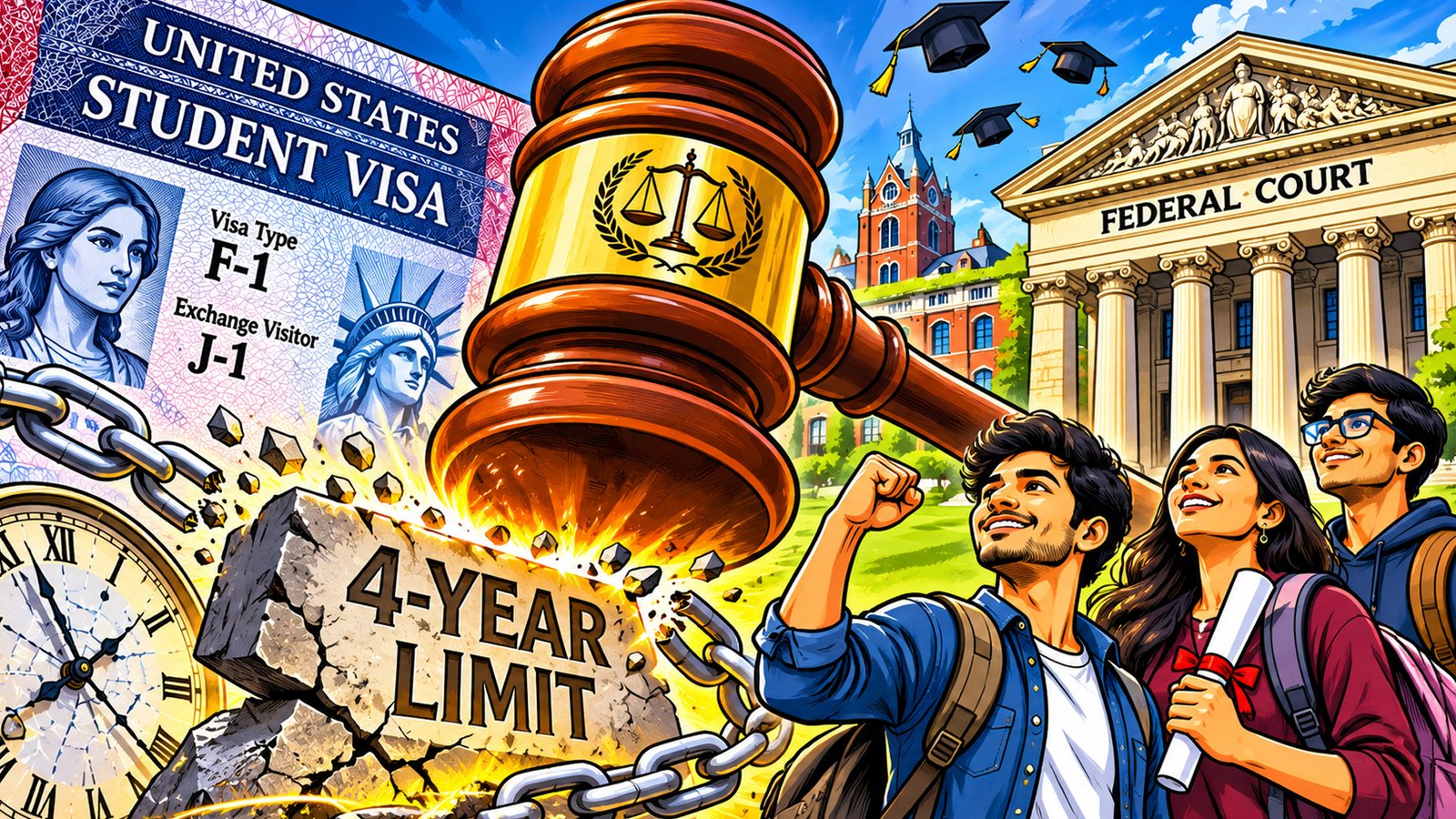
The decision effectively blocks the proposed four-year stay limit for international students and the 240-day admission limit for foreign journalists. It also preserves the existing Duration of Status framework, which allows eligible foreign students to remain in the US for the period required to complete their authorised academic programmes.
The judgment comes at a time when immigration policies under US President Donald Trump have become a major concern for international students, researchers and professionals, particularly those from India.
The rule, published on July 17, 2026, covered three major visa categories. These included F-1 visas for international students, J-1 visas for exchange visitors, researchers, professors and instructors, and I visas issued to foreign journalists and media representatives.
Under the proposed changes, F-1 students would have been allowed to remain in the US only until the end of their academic programme or for four years, whichever came first. Those requiring additional time would have had to apply for an extension through a new approval process.
J-1 exchange visitors would also have faced a maximum four-year stay, subject to the requirements of their programmes. Foreign journalists holding I visas, meanwhile, would have been permitted an initial stay of up to 240 days or until the completion of their assignments, whichever was earlier. They would have needed to seek extensions to continue working in the country.
The Trump administration had defended the changes on grounds of national security, immigration oversight and the need to prevent visa fraud. It argued that fixed admission periods would help authorities monitor foreign nationals and ensure they complied with the conditions of their visas.
However, the court found that the Department of Homeland Security had failed to provide sufficient evidence to justify such sweeping changes. It also questioned whether the government had properly examined the financial and administrative consequences of the policy or considered less restrictive alternatives.
A key concern raised during the proceedings was the availability of an existing monitoring mechanism known as the Student and Exchange Visitor Information System (SEVIS). The system allows US authorities to track international students and exchange visitors through regular reporting by educational institutions and programme sponsors.
The judge observed that the government had not adequately explained why the existing system could not be strengthened to address concerns about immigration violations. He also questioned how introducing a fresh extension procedure after four years would significantly improve the detection of fraudulent activity.
The court raised concerns about the possible impact on academic freedom and international education. Under the proposed policy, students could have encountered difficulties when changing their academic specialisations, transferring institutions, pursuing joint degrees or enrolling in additional qualifications at the same or a lower academic level.
This could have created serious complications for students pursuing longer academic programmes, particularly doctoral research and specialised courses that often require more than four years to complete.
The legal challenge was filed by a coalition of higher education organisations, labour unions and media representatives. The plaintiffs included NAFSA: Association of International Educators, the Presidents’ Alliance on Higher Education and Immigration, the American Federation of Teachers and The NewsGuild-CWA, among others.
The organisations argued that the proposed restrictions would create unnecessary hurdles for international students, universities and foreign journalists. They also maintained that the administration had failed to demonstrate why the existing immigration monitoring arrangements were inadequate.
The November 16 judgment marks an important development in the case. Unlike the September 14 preliminary injunction, which had temporarily prevented the government from implementing the rule, the latest decision grants final judgment in favour of the organisations challenging the policy and overturns the rule in its entirety.
The decision carries particular significance for India, which continues to be the largest source of international students in the US.
According to the Institute of International Education’s Open Doors 2026 report, 339,435 Indian students were enrolled in US institutions during the 2025-26 academic year. This represented 29.6% of the international student population, although enrolment declined by 6% compared with the previous year.
Of the total, 182,201 Indian students were participating in Optional Practical Training (OPT), which allows eligible international graduates to gain temporary work experience related to their field of study.
The latest ruling is especially relevant for Indian students pursuing postgraduate education, doctoral research and other extended academic programmes. Had the proposed restrictions taken effect, students needing additional time to complete their courses could have faced repeated extension applications and greater uncertainty about their immigration status.
The judgment also protects the existing framework for Indian journalists working in the US on I visas. The proposed 240-day limit could have disrupted longer reporting assignments and created additional administrative challenges for foreign media organisations.
However, the ruling does not mean that visa holders can remain in the US indefinitely. They must continue to comply with the conditions of their respective visa categories and maintain their authorised academic or professional status.
It is also important to distinguish between visa validity and authorised duration of stay. A visa generally allows a foreign national to seek entry into the US, while the Duration of Status framework determines how long eligible students and exchange visitors can remain in the country while meeting the requirements of their programmes.
The US government could still challenge the latest judgment through a separate appeal. However, the earlier appeal against the September preliminary injunction may become moot following the final decision. Unless the November 16 judgment is stayed or reversed, the existing Duration of Status framework will remain in force nationwide.