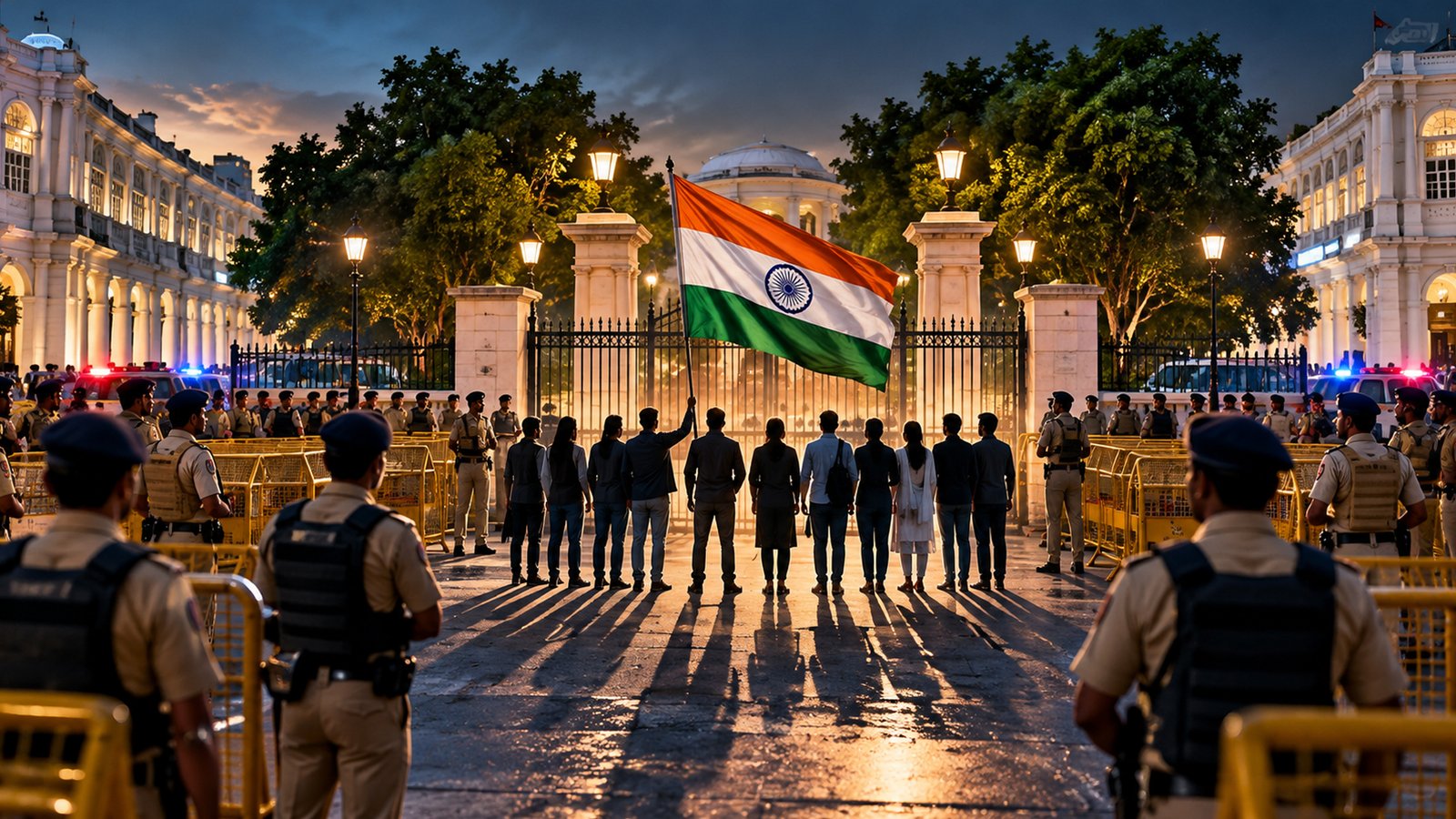
Delhi is on high alert on Friday, October 16, as the Cockroach Janta Party (CJP) prepares to hold its “Lehra Do Tiranga” march at Connaught Place. The protest, called by party founder Abhijeet Dipke, comes amid a growing dispute over the arrest of two CJP leaders and demands for the resignation of Chief Election Commissioner Gyanesh Kumar.
The proposed demonstration has prompted heightened security across central Delhi, with police barricades, additional personnel and restrictions on public gatherings. The New Delhi Municipal Council (NDMC) has also announced that Central Park, the proposed protest venue, will remain closed to the public on October 16 and 17.
The march is scheduled for 5 pm, but uncertainty remains over how the gathering will proceed because prohibitory orders are in force. Police have urged people to stay away from unauthorised assemblies and said they may facilitate a small group to carry the national flag and sing the national anthem at a suitable location.
Why is CJP organising the Tiranga march?
The protest follows the detention and judicial custody of CJP leaders Saurav Das and Ashutosh Ranka. The two were sent to five days of judicial custody after allegedly entering Jantar Mantar, which is no longer a designated protest site, and violating restrictions linked to their peace bonds.
Their detention has become a rallying point for the party and its supporters. Dipke has argued that displaying the national flag should not be treated as a crime and has called on citizens, student groups and political organisations to join the demonstration.
The CJP’s campaign also centres on the role of the Election Commission of India and the revision of electoral rolls. The party is demanding the resignation of Chief Election Commissioner Gyanesh Kumar, alleging irregularities in the voter-list revision process.
The dispute has drawn the attention of opposition groups and student organisations, adding to the pressure on authorities as they attempt to maintain public order in the capital.
Voter-list revision row fuels protests
The protests are linked to concerns surrounding the Special Intensive Revision (SIR) of electoral rolls. Critics have alleged that the exercise resulted in the deletion of a large number of voters and questioned whether the process was carried out fairly.
The Election Commission has denied allegations of favouring any political party. It has maintained that voters whose names were wrongly removed can re-enrol through the prescribed process.
The BJP, meanwhile, has accused its critics of undermining confidence in democratic institutions by questioning the electoral process.
The controversy has continued to fuel demonstrations in Delhi, with protesters demanding accountability and greater transparency in the preparation of voter lists. The latest march is intended to combine these demands with a show of support for the detained CJP leaders.
What did the Delhi High Court say?
The Delhi High Court on Thursday declined to issue an order stopping the proposed march at Central Park. The court recorded the Delhi Police’s assurance that it would take all possible legal measures to regulate the gathering and maintain law and order.
The case followed a petition by a Connaught Place vendor who raised concerns about the impact of protests on local businesses, commuters and pedestrians. The petitioner argued that a demonstration in the busy commercial area could disrupt business, particularly during the festive season.
The court’s decision did not amount to unconditional permission for the protest. Instead, it left the police responsible for regulating the gathering in accordance with the law.
The matter is expected to return for further consideration on November 3. The legal dispute highlights the challenge of balancing the right to peaceful protest with public safety and the livelihoods of traders.
Central Park closure and security restrictions
The NDMC’s decision to close Central Park for two days has added uncertainty to the CJP’s plans. Authorities have cited administrative reasons for the closure, while the move comes amid concerns about a possible gathering at the site.
Delhi Police has imposed prohibitory restrictions under Section 163 of the Bharatiya Nagarik Suraksha Sanhita (BNSS) in Connaught Place and nearby areas. Such orders can restrict assemblies when authorities believe they are necessary to prevent disturbances or protect public safety.
Police have also warned commuters about possible traffic congestion and restrictions around central Delhi. Office-goers, shoppers and people travelling through Connaught Place have been advised to plan their journeys carefully.
Officials have indicated that permitted protest venues include Ramlila Maidan, Burari Ground and CBD Ground, subject to the necessary approvals.
Traders raise concerns over business losses
The proposed march has also sparked concern among Connaught Place traders. The area is one of Delhi’s major shopping and dining destinations, and businesses fear that security restrictions, road closures and reduced footfall could affect sales during the festive period.
Some traders have approached the Supreme Court, seeking intervention over the disruption they say repeated demonstrations have caused. They have also raised concerns about losses associated with earlier protest-related restrictions.
The issue has placed local businesses and civil liberties at the centre of a wider debate over how demonstrations should be managed in busy commercial districts.
As Delhi awaits developments around the CJP’s Tiranga march, the focus remains on whether the protest can proceed without a confrontation. The authorities face the task of maintaining order while respecting lawful democratic expression, as the dispute over voter-list revisions and the treatment of the detained activists continues.