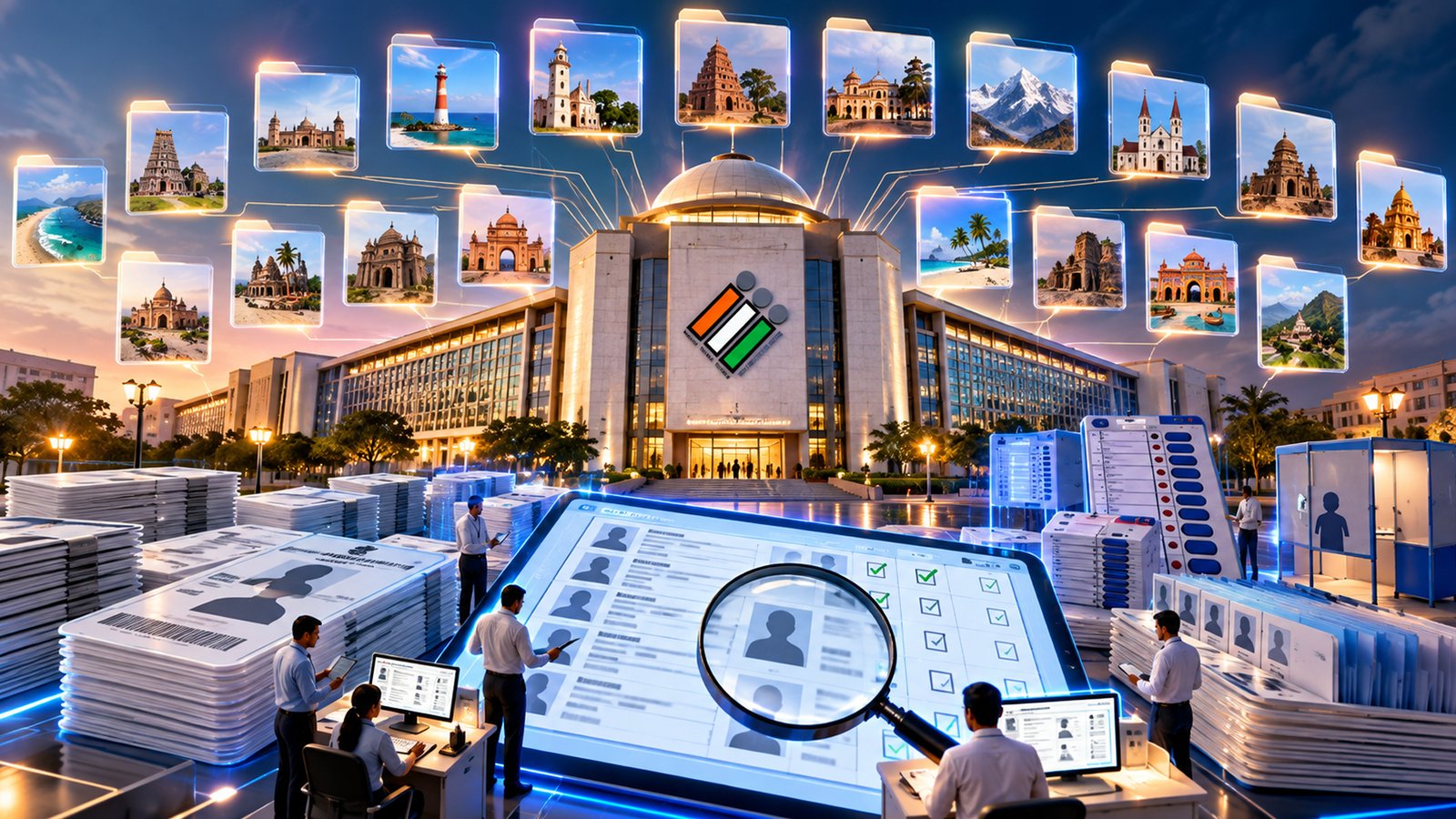
The Election Commission of India (ECI) has announced a Special Summary Revision (SSR) of electoral rolls in 17 states and Union territories, with the exercise scheduled to begin in November. The move aims to update voter lists, include eligible citizens who are missing from the rolls and correct errors before several states head into assembly elections next year.
The revision will use January 1, 2027, as the qualifying date for voter eligibility. The states and Union territories covered include Uttar Pradesh, Uttarakhand, Goa, Punjab and Manipur, where assembly elections are expected early next year. The exercise will also cover other regions to ensure that electoral rolls remain accurate and up to date.
The Election Commission has introduced an important change in how voter lists will be shared with political parties. Draft and final electoral rolls, without photographs, must be provided in a readable PDF format instead of image-based PDFs. The move responds to a long-standing demand from political parties for voter lists that are easier to read, search and analyse.
The readable format is expected to make it easier to check voter entries and identify possible errors or omissions. At the draft stage, political parties will also receive supplements showing additions, deletions and changes to the electoral rolls.
The Commission has asked state and Union territory election officials to follow the revision schedule and ensure that the process is completed within the prescribed deadlines.
The 17 states and Union territories covered are Andaman and Nicobar Islands, Assam, Bihar, Chhattisgarh, Goa, Gujarat, Kerala, Lakshadweep, Madhya Pradesh, Manipur, Puducherry, Punjab, Rajasthan, Tamil Nadu, Uttar Pradesh, Uttarakhand and West Bengal.
Under the announced schedule, polling stations will be rationalised by November 2. The draft electoral rolls will be published on November 12, giving voters an opportunity to check whether their names and details are correctly recorded.
The period for filing claims and objections will remain open until December 11. Election officials are expected to examine and dispose of these claims by December 28. The final electoral rolls are scheduled to be published on January 4, 2027.
Voters should check the draft list carefully once it becomes available. Those who find that their names are missing, or that details such as their address or spelling are incorrect, can use the prescribed process to seek inclusion or correction. Citizens can also submit objections against entries that they believe should not remain on the list.
The revision is particularly important for young people who will become eligible to vote around the qualifying date. Eligible citizens who have not yet registered are being encouraged to apply for inclusion. The Election Commission has also directed officials to conduct a special drive to enrol young and first-time voters who may have been left out.
The qualifying date determines whether a person meets the age requirement for registration. In general, an Indian citizen who has turned 18 by the relevant qualifying date and is not otherwise disqualified under the law can seek inclusion in the electoral roll.
The Commission has also allowed advance applications for people who will become eligible on other qualifying dates in 2027: April 1, July 1 and October 1. This is intended to make registration easier for young citizens approaching voting age rather than requiring them to wait until a later revision.
The latest exercise is a Special Summary Revision, which is different from the Special Intensive Revision (SIR) that has drawn political attention and criticism in several parts of the country.
A summary revision generally updates the existing electoral roll by adding eligible voters, correcting details and removing entries where appropriate. An intensive revision involves a more extensive verification exercise. The distinction matters because the two processes have different procedures and schedules.
The Election Commission said the schedule for states and Union territories where the intensive revision is ongoing or has recently concluded would be announced separately. These include regions such as Delhi, Maharashtra, Karnataka, Telangana and Odisha. Himachal Pradesh, Jammu and Kashmir, and Ladakh will also follow a separate schedule, with weather conditions taken into account.
The announcement comes as the Election Commission prepares for elections in several states in 2027. An accurate voter list is essential to ensure that eligible citizens can exercise their voting rights and that electoral records do not contain incorrect or duplicate entries.
The use of readable PDF files could also make it easier for political parties to scrutinise the rolls and raise specific concerns during the claims and objections period. However, the effectiveness of the exercise will depend on how quickly officials address genuine complaints and how easily voters can access the relevant information.
For citizens, the immediate priority is to verify their details when the draft rolls are published on November 12. Checking early will give voters time to seek corrections before the final list is released in January. The exercise is intended to improve the accuracy of electoral rolls and help ensure that eligible voters are not left out ahead of the next round of assembly elections.