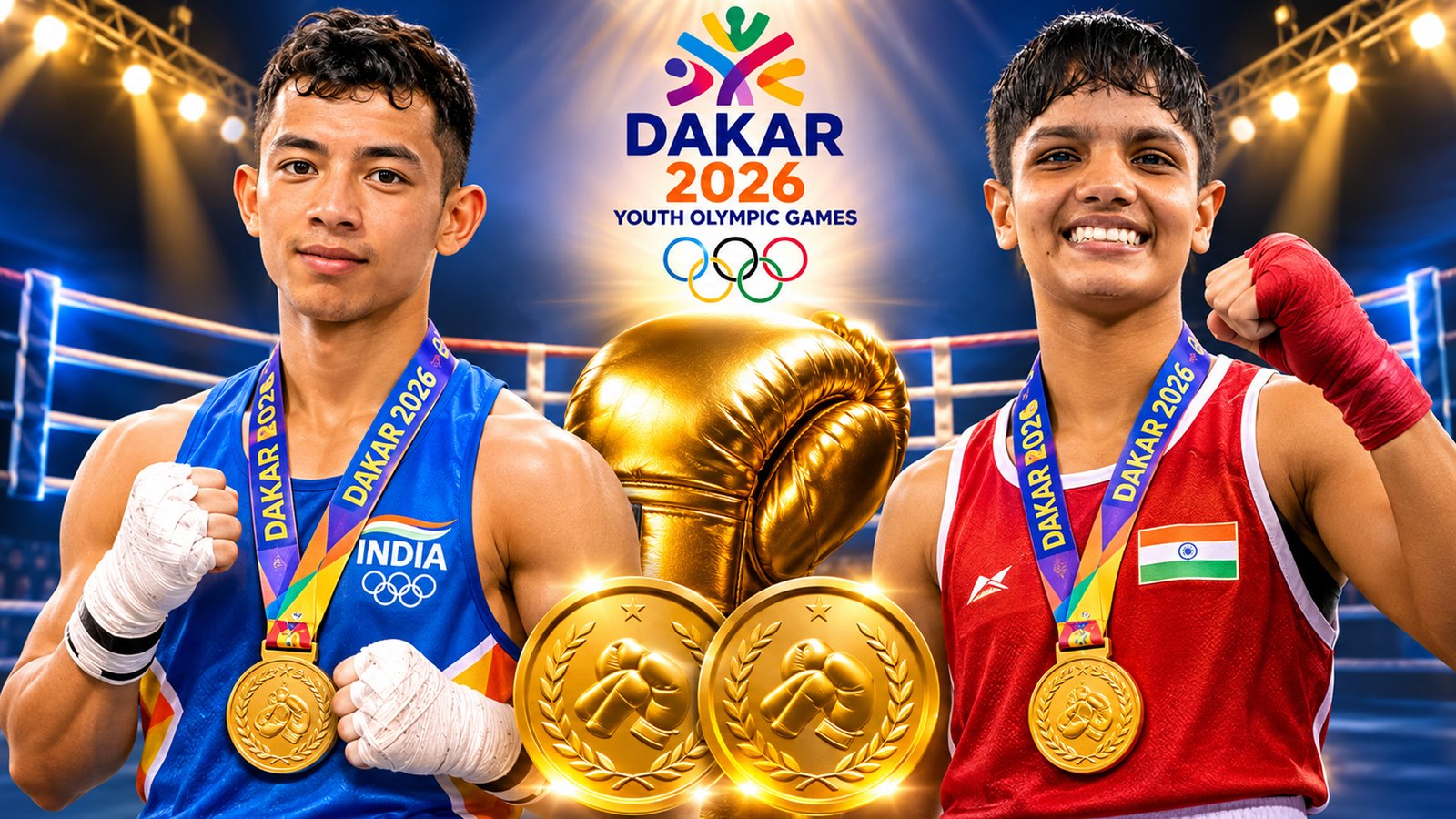
Indian boxing celebrated a landmark achievement at the 2026 Youth Olympic Games in Dakar, Senegal, as Lairenlakpam Ambekar Meetei and Gunjan won gold medals in their respective categories. Their victories not only brought India its first-ever boxing gold medals at the Youth Olympics but also marked a significant moment for the country’s emerging sporting talent.
Ambekar Meetei won the men’s 50kg final against Ireland’s Kristian Jubani, securing a closely contested 3-2 victory. Gunjan followed with an impressive performance in the women’s 48kg final, defeating Algeria’s Bouthaina Bensalah by a unanimous 5-0 decision. Both Indian boxers finished their campaigns at the top of the podium, giving the country a memorable double gold in Dakar.
The achievement is particularly important because India had never won a boxing gold medal at the Youth Olympic Games since the competition began in 2010. The twin victories also represented the first time an Indian male boxer and an Indian woman boxer had won gold at the event.
Ambekar’s victory was especially dramatic. The boxer from Manipur had to overcome a difficult start against Jubani, who dominated the opening round and received favourable scores from all five judges. However, the Indian youngster gradually found his rhythm and changed the direction of the contest in the second round.
Ambekar increased the pressure with a series of strong punches and forced a standing eight count against his Irish opponent. The momentum shifted further in the final round when the Indian landed a powerful right hand. His aggressive finish convinced three of the five judges, who scored the bout 29-28 in his favour. Two judges favoured Jubani, making it a 3-2 split-decision victory for the Indian.
The win made Ambekar the first Indian boxer to become a Youth Olympic champion. It also ended a 16-year wait for India to see a boxer reach the top of the podium at the competition.
Before Ambekar, Shiva Thapa had come closest to winning the title when he secured silver in the men’s 54kg category at the inaugural Youth Olympics in Singapore in 2010. Vikas Krishan had also won bronze in the men’s 60kg category during the same edition. Ambekar has now taken Indian boxing beyond those earlier achievements.
His gold-medal performance is the result of years of training and steady progress through the junior boxing circuit. A student of the National Sports Academy at the Khuman Lampak Sports Complex in Imphal, Ambekar took up boxing in 2018 after his maternal uncle, Khadem Sukumar, encouraged him to try the sport.
His uncle believed that his physical strength and build could make him suitable for boxing. What began as an encouragement gradually developed into a serious sporting pursuit. Ambekar later trained at the national camp in Patiala under coaches Vijay Kumar Sharma and Geeta Chanu Oinam.
The young boxer also entered the Dakar competition with confidence after winning a silver medal at the World Boxing Futures Cup in Bangkok earlier this year. His performances against opponents from Senegal, Namibia and Colombia helped him secure a place in the final before he produced his biggest result against Ireland.
Gunjan’s victory added another historic chapter to India’s Youth Olympics boxing campaign. Competing in the women’s 48kg category, she delivered a commanding performance against Algeria’s Bouthaina Bensalah. Unlike Ambekar’s closely fought contest, Gunjan controlled the bout across all three rounds and received a unanimous 5-0 verdict from the judges.
Her victory made her the first Indian woman boxer to win a gold medal at the Youth Olympic Games. The achievement is also an important boost for women’s boxing in India, which has steadily gained recognition through performances at international competitions.
Gunjan had displayed consistency throughout the tournament. Her victories in the earlier rounds, including against Great Britain’s Lily Bassett in the semifinals, helped her reach the gold-medal contest. She then completed her campaign with an emphatic win over Bensalah.
The Boxing Federation of India welcomed the performances, describing the double gold as a historic moment for Indian sport. Its president, Ajay Singh, said the achievement reflected the growing depth of talent in Indian boxing and the progress being made in developing young athletes.
The two victories also contributed significantly to India’s overall performance at the Dakar 2026 Youth Olympic Games. The Indian contingent finished the competition with 10 medals, comprising two gold, three silver and five bronze medals. This made it India’s second-best performance in the history of the Youth Olympics.
India’s best campaign remains the 2018 edition, when the country collected 13 medals, including three gold, nine silver and one bronze. The Dakar medal tally represents another encouraging performance, particularly because of the historic achievements in boxing.
Apart from the two boxing gold medals, Indian athletes also secured podium finishes in athletics, wrestling, swimming, badminton, judo and wushu. Shourya Ambure won bronze in the women’s 100m hurdles, while Taniya claimed silver in wrestling. Khushbu Rajakbhai Darjada and Tanvi Patri added silver medals in judo and badminton, respectively.
Swimming also contributed three bronze medals through Dhinidhi Desinghu, who won two medals in the women’s freestyle events, and Tirthank Pegu, who finished third in the men’s 200m butterfly. Rajkumari Lanchenbi Chanu secured another bronze in wushu.
The performances in Dakar underline the importance of identifying and supporting young athletes through structured training, national camps and international exposure. For Indian boxing, the success of Ambekar Meetei and Gunjan offers particular encouragement ahead of future senior-level competitions.
Their victories are more than just two additional medals for India. They represent a breakthrough for a new generation of boxers and provide a strong foundation for the country’s ambitions in international boxing. The challenge now will be to help these young champions maintain their progress as they move towards senior competitions and bigger sporting stages.