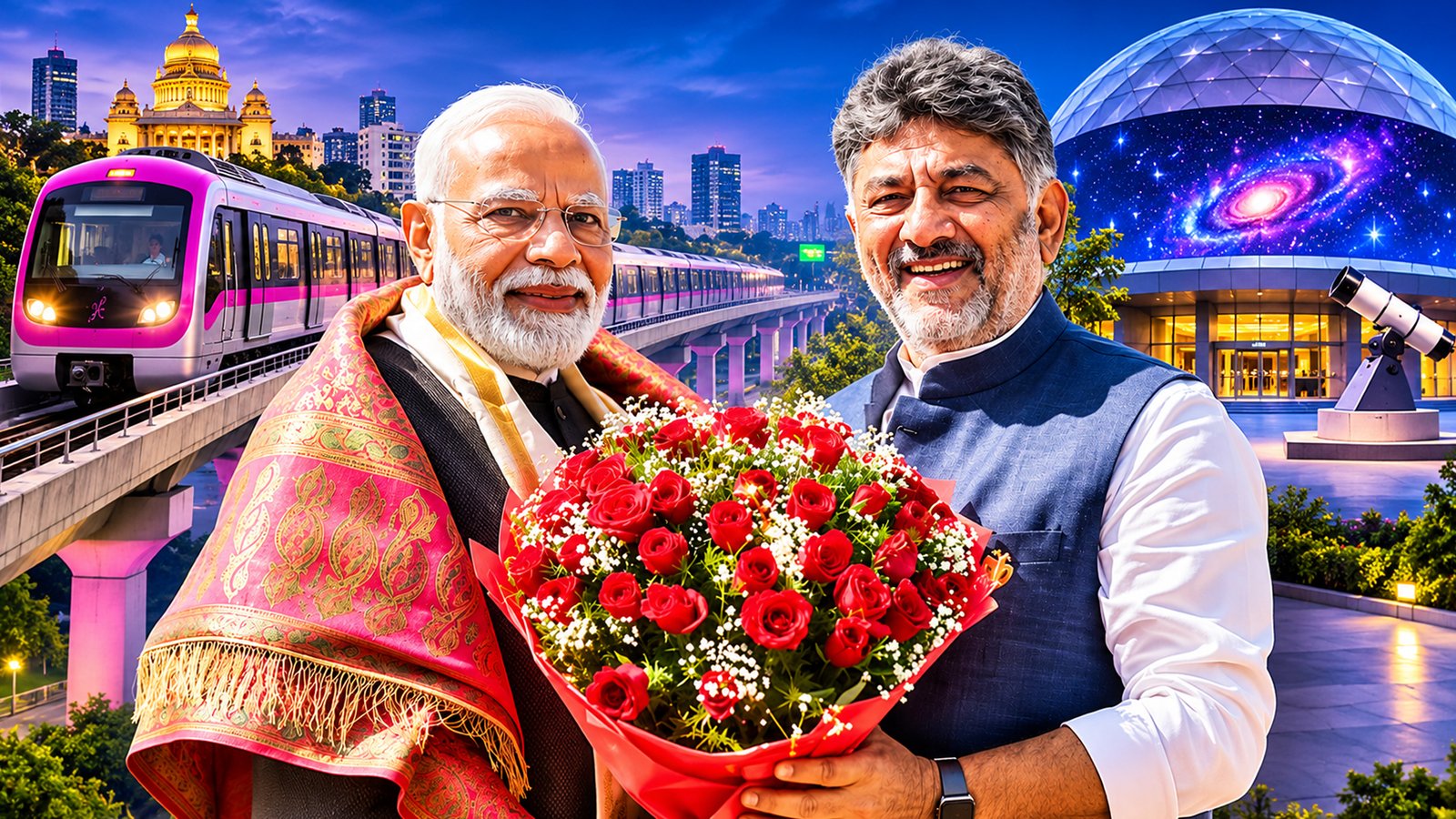
Prime Minister Narendra Modi inaugurated Bengaluru Metro’s Pink Line and India’s first LED Dome Planetarium in Mysuru, on Friday, November 13, marking two significant developments in Karnataka’s urban infrastructure and science education. The inaugurations formed part of his two-day Karnataka and Gujarat visit, during which development projects worth more than Rs 15,600 crore were launched, dedicated to the nation or taken up for their foundation stones in Bengaluru.
The opening of the Namma Metro Pink Line is expected to improve public transport connectivity in Bengaluru, a city where growing traffic congestion and longer commuting hours have become major concerns for residents. PM Modi inaugurated the elevated section connecting Kalena Agrahara to Tavarekere and also travelled on the newly opened stretch, accompanied by Karnataka Deputy Chief Minister D K Shivakumar.
Developed at an estimated cost of Rs 3,470 crore, the 7.5-km elevated corridor is the first operational section of the Pink Line under Bengaluru Metro’s Phase 2 network. It has six stations: Kalena Agrahara, Hulimavu, IIM Bangalore, JP Nagar 4th Phase, Jayadeva Hospital and Tavarekere. The route runs along Bannerghatta Road and is expected to benefit commuters travelling through some of the city’s busy residential, commercial and institutional areas.
The new stretch is particularly important for people travelling towards IIM Bangalore, JP Nagar and the Bannerghatta Road region. Improved metro connectivity could encourage more commuters to shift from private vehicles to public transport, helping reduce pressure on major roads and making everyday journeys more predictable.
The elevated section is part of a much larger 21.26-km Pink Line corridor that will eventually connect Kalena Agrahara in south Bengaluru with Nagawara in the north. The complete route will have 18 stations, combining the operational 7.5-km elevated stretch with a 13.76-km underground section.
The underground portion, which will connect several important areas of central Bengaluru, is expected to become operational by mid-2027. Once the entire corridor is ready, the Pink Line will provide connectivity to important locations, including MG Road and Pottery Town, besides IIM Bangalore, JP Nagar and Hulimavu. The expansion is expected to strengthen Bengaluru’s metro network and provide commuters with an alternative to road transport.
The project has also received financial assistance from Japan through the Japan International Cooperation Agency (JICA), which has supported Bengaluru Metro Phase 2 through an official development assistance loan. The assistance covers signalling and train control systems, rolling stock and consultancy services.
From urban mobility, PM Modi’s Karnataka visit moved to science and education with the inauguration of COSMOS-Mysuru Planetarium, located on the University of Mysore campus near the foothills of Chamundi Hills. Built by the Indian Institute of Astrophysics, the facility is India’s first LED Dome Planetarium and is designed to make astronomy more accessible to students, researchers and the general public.
The planetarium introduces a different approach to presenting astronomical images. Unlike conventional facilities that use projectors to display visuals on a passive dome, COSMOS features a 15-metre tilted dome fitted with around 6,150 LED panels containing approximately 4.2 crore individual LEDs. The panels can be controlled in real time, creating an immersive viewing experience for visitors.
The facility’s Sky Theatre will screen professionally produced astronomy programmes and an in-house film exploring the relationship between Mysuru’s history and astronomy. The shows will be available in Kannada, English and Hindi, allowing students and visitors from different linguistic backgrounds to access the content.
Besides the main theatre, COSMOS will house exhibition halls, a museum displaying astronomy models and artefacts, a lecture hall, a training centre and interactive outdoor exhibits. The institution is intended to serve as an astronomy education and training centre, while supporting research and scientific outreach activities.
Addressing the inauguration, PM Modi said the planetarium would inspire young people to explore the mysteries of the universe and develop an interest in scientific research. He urged the institution’s management to coordinate with schools and colleges and arrange visits for students so that more children could experience the facility.
The Prime Minister also highlighted India’s achievements in space exploration, referring to the Chandrayaan-3 mission, Aditya-L1 solar observatory and the country’s progress in developing space-docking capabilities. He said the expansion of India’s space sector had created opportunities for private companies and start-ups to develop rockets, launch satellites and participate in advanced research.
PM Modi also referred to the achievements of Indian students in international science competitions. He noted that five Indian participants had represented the country at the International Olympiad on Astronomy and Astrophysics in Vietnam this year, with four winning gold medals and one securing silver.
He said young people could achieve remarkable results when provided with opportunities, modern technology, resources and institutional support. The planetarium, he added, could help nurture scientific curiosity and encourage future generations to pursue discoveries.
The Prime Minister’s Karnataka visit also included the inauguration of the new Yesvantpur-Madgaon Vande Bharat Express, strengthening rail connectivity between Bengaluru, coastal Karnataka and Goa. Regular services are scheduled to begin on November 15. The train will connect destinations such as Hassan, Sakleshpur, Mangaluru, Udupi, Murdeshwar, Gokarna and Karwar.
The two inaugurations underline different aspects of Karnataka’s development priorities. While the Bengaluru Metro Pink Line aims to address the immediate challenges of urban transport, the Mysuru planetarium seeks to create opportunities for scientific learning and research. Together, the projects highlight the state’s expanding focus on infrastructure, technology, education and public services.