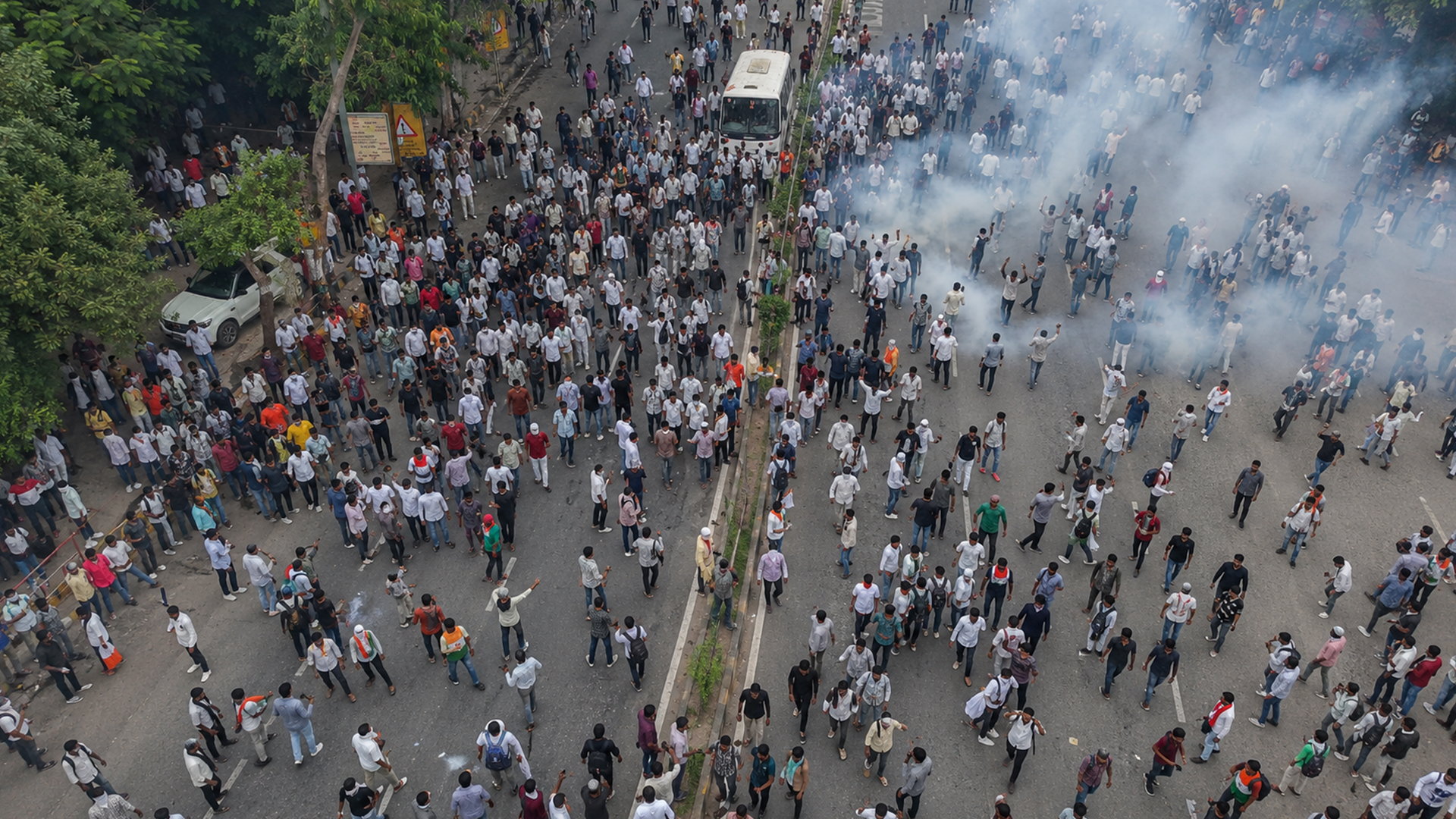
The student-led protest at Delhi’s Jantar Mantar gathered fresh momentum on Wednesday, with thousands of students, parents, teachers and civil society members continuing their agitation over the alleged NEET paper leak and demanding sweeping reforms in India’s examination system. Entering its third day, the demonstration has evolved into a nationwide movement calling for transparency, accountability and justice for millions of students who aspire to secure admissions through competitive examinations.
Organised under the banner of the Cockroach Janta Party (CJP), the protest has drawn participants from across the country. Students carrying placards, waving the national flag and chanting slogans gathered at Jantar Mantar from early morning, insisting that they would continue their peaceful movement until the government addressed their concerns.
The protesters are demanding the resignation of Union Education Minister Dharmendra Pradhan, an independent and transparent investigation into the alleged irregularities in national entrance examinations, and comprehensive reforms to restore public confidence in the examination system. On Wednesday, the CJP added a fourth demand, seeking compensation for the families of students who allegedly died by suicide due to examination-related stress and the uncertainty created by repeated paper leak controversies.
The atmosphere at the protest site remained determined yet peaceful. Many students spoke about spending years preparing for highly competitive examinations, only to see their dreams clouded by allegations of question paper leaks and irregularities. Parents who travelled from different states said they were standing beside their children because the issue affected the future of an entire generation.
“Our fight is not against examinations. It is for a fair examination system where every student’s hard work is respected,” said one protester, echoing the sentiment shared by many at the venue.
The protest has also gained attention for its unusual symbolism. Members of the CJP have adopted the cockroach as the movement’s symbol, describing it as a representation of resilience and survival. Protesters dressed in cockroach costumes and carried symbolic props to underline their message that ordinary students would continue their struggle despite attempts to suppress their voices.
Security remained tight across central Delhi as authorities monitored the growing crowds. In view of the demonstrations, the Delhi Metro Rail Corporation (DMRC) temporarily closed 16 Metro stations, including Rajiv Chowk, Janpath, Patel Chowk and Central Secretariat, citing security concerns. Police personnel were deployed in large numbers around Jantar Mantar to maintain law and order, while traffic diversions were enforced in several areas.
Despite the security arrangements, the protest remained peaceful. Organisers urged participants to avoid violence and continue their campaign through democratic means.
CJP spokesperson Ashutosh Ranka said the movement was only beginning and warned that it would intensify if the government failed to respond. Referring to earlier demonstrations, he said they were merely a “trailer” and asserted that protesters were prepared to face arrests if necessary. According to him, the campaign would continue until meaningful action was taken to protect the interests of students.
The agitation has received a further emotional boost from activist and innovator Sonam Wangchuk, whose indefinite hunger strike has become a symbol of the campaign. Wangchuk is currently undergoing treatment at Medanta Hospital in Gurugram after being shifted from Safdarjung Hospital under the directions of the Delhi High Court. His health continues to be closely monitored, and many protesters carried banners wishing him a speedy recovery while reaffirming their support for his cause.
Political attention around the protests also intensified on Wednesday. Several opposition leaders expressed solidarity with the students and criticised the government’s handling of the examination controversy. At the same time, CJP leaders maintained that the movement belongs to students and citizens rather than political parties, stressing that their focus remains on education reforms and accountability.
Support for the agitation has continued to grow beyond the protest venue. In a remarkable show of solidarity, people from different parts of the country have been sending food, water and other essentials to the protesters through online delivery platforms. Volunteers at Jantar Mantar said deliveries from well-wishers had been arriving throughout the day, highlighting the widespread public support the movement has generated.
The campaign has also crossed national borders. Members of the Indian diaspora organised solidarity demonstrations in New York and San Jose, California, expressing concern over Wangchuk’s health and backing the students’ demand for a transparent and credible examination system. Holding placards and raising slogans, supporters called for fairness and accountability, reflecting the growing international attention the protest has attracted.
Education experts believe the movement has exposed deeper concerns surrounding India’s competitive examination system. They say stronger safeguards against paper leaks, greater transparency in conducting examinations and quicker action against irregularities are essential to restore trust among students and parents.
As the crowds at Jantar Mantar continue to grow, the protest is emerging as one of the country’s largest youth-led movements in recent years. For many students, the issue goes beyond a single examination. They say it is about protecting the value of hard work, ensuring equal opportunities and rebuilding faith in a system that shapes the future of millions.
With the agitation gathering nationwide momentum and public support expanding across India and overseas, all eyes are now on the government’s next move. Whether through dialogue, policy reforms or administrative action, the response in the coming days is expected to determine the course of a movement that has become the voice of countless young aspirants seeking fairness, transparency and justice.