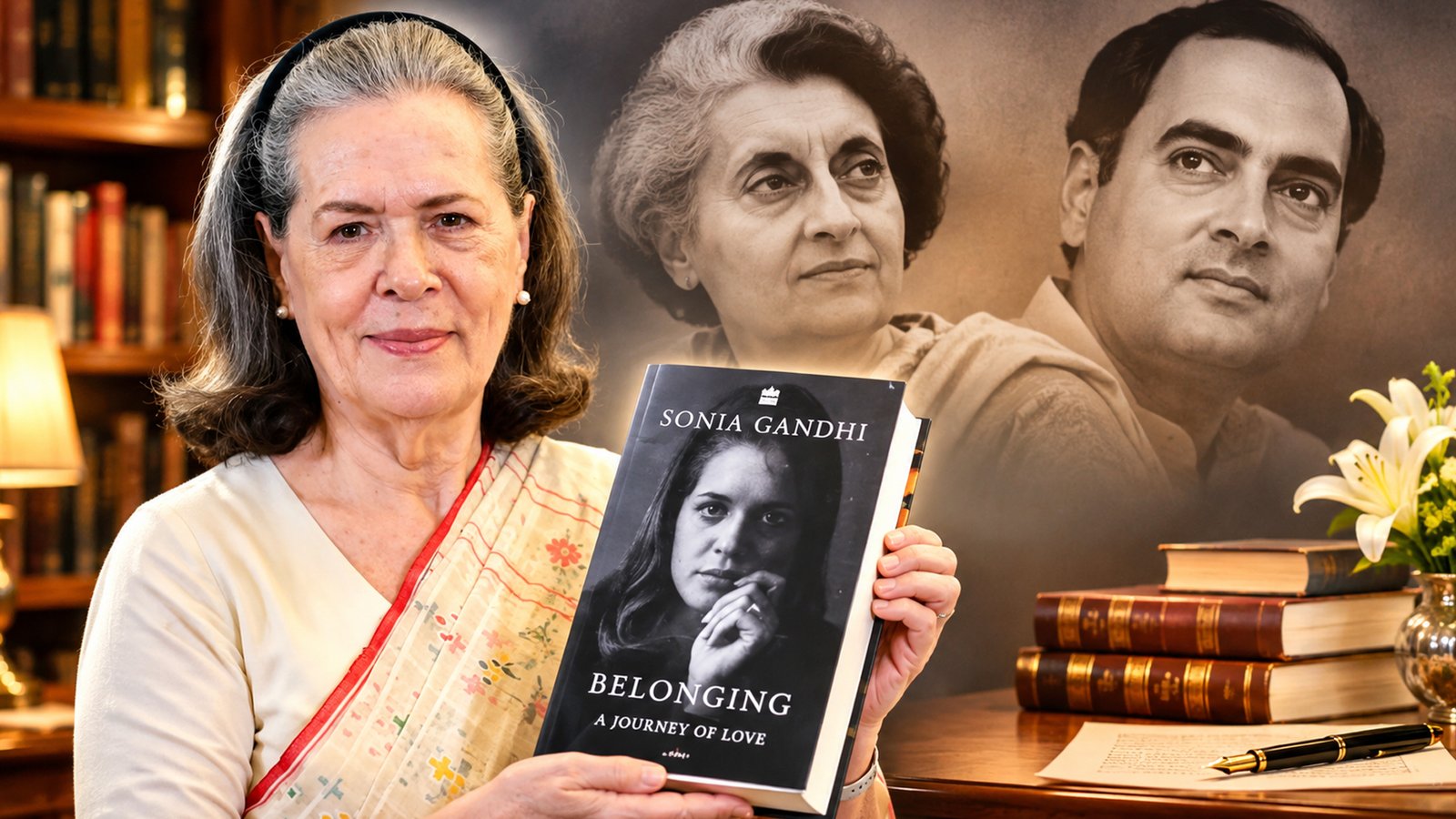
Sonia Gandhi’s memoir, Belonging: A Journey of Love, has brought several personal memories and political controversies back into the spotlight. From her gesture of solidarity towards the wives of jailed chief ministers to an unusual Christmas visit to Tihar Jail in 1978, the book offers glimpses into episodes from her life that continue to attract public attention.
The memoir has also triggered fresh political exchanges between the Congress and the Bharatiya Janata Party (BJP), with Prime Minister Narendra Modi revisiting an old controversy involving Gujarat’s economic ranking and economist Bibek Debroy.
One of the most discussed episodes concerns Sonia Gandhi’s interaction with Kalpana Soren, wife of Jharkhand Chief Minister Hemant Soren, and Sunita Kejriwal, wife of former Delhi Chief Minister Arvind Kejriwal. Both chief ministers were in prison when Sonia met their wives at an INDIA bloc rally in Delhi in 2024.
In her memoir, Sonia recalls approaching the two women and embracing them. She understood the difficult position they were in, having to manage family responsibilities and public life while their husbands remained behind bars. Her gesture, she suggests, was an expression of empathy rather than a political statement.
The account has received appreciation from Congress leader Rajesh Thakur, who described the gesture as an example of human solidarity.
Thakur said Sonia’s response reflected compassion and sensitivity towards women dealing with difficult circumstances. He also pointed out that women have historically stepped forward to take on responsibilities during periods of political uncertainty.
He drew a comparison with the Quit India Movement, when women played an important role in the freedom struggle despite the imprisonment of several prominent leaders.
The episode is significant given the complicated political relationship between the Congress and the Aam Aadmi Party (AAP). Although both parties are part of the INDIA opposition alliance, they have frequently disagreed on political issues. Sonia’s account highlights how personal empathy can sometimes take precedence over political differences.
Another striking recollection in the memoir takes readers back to Christmas Day in 1978, when Sonia visited Tihar Jail carrying a special meal for her mother-in-law, former Prime Minister Indira Gandhi.
Indira was imprisoned after the Janata Party came to power following the Emergency. Sonia recalls that she visited the jail regularly during this period and wanted to make Christmas special for her mother-in-law.
She prepared a meal consisting of soup, vegetables, roast chicken and Christmas pudding. However, Indira wanted the food to be shared with others in the prison compound, including three women guards and a young Australian woman prisoner.
According to Sonia’s account, the prisoner was an associate of notorious serial killer Charles Sobhraj. Indira reportedly felt sorry for the young woman and wanted her to be included in the Christmas celebrations.
When the family learnt that the prisoner did not eat ham, they changed the menu to roast chicken.
Sonia also recalls that Indira initially discouraged her from visiting the prison, asking her to spend Christmas with Rajiv Gandhi and their children instead. However, Sonia went ahead with the visit, carrying food, a book and Christmas cards from the children.
Indira was released from prison the following day.
The incident offers an unusual insight into the Gandhi family’s personal experiences during a politically difficult period. It also reveals a lesser-known side of Indira Gandhi, whose concern extended to another prisoner despite the circumstances.
Meanwhile, the memoir has revived a separate political controversy involving PM Modi, Gujarat and economist Bibek Debroy.
Speaking at an agriculture conference in New Delhi on November 12, PM Modi recalled the controversy surrounding Gujarat’s top position in an economic freedom ranking of Indian states during his tenure as chief minister.
The ranking was based on research by economists, including Debroy, and was published in 2004. The report placed Gujarat at the top, prompting allegations that the findings had upset political leaders in Delhi.
Debroy had subsequently alleged that he faced pressure after the report was published. In a 2015 interview, he claimed that he was informed that publications by the Rajiv Gandhi Institute for Contemporary Studies (RGICS) would require political approval.
Sonia Gandhi was then associated with the institute as chairperson of its parent organisation, the Rajiv Gandhi Foundation.
Debroy alleged that the instruction was communicated through a document bearing Sonia Gandhi’s signature and said he eventually left the institute.
The Congress disputed his claims, maintaining that Debroy’s departure followed the completion of his contractual tenure. The party also released documents to challenge his version of events.
PM Modi’s latest remarks have brought the decade-old controversy back into political discussion, adding to the attention surrounding Sonia’s memoir.
The book has also attracted political criticism over its references to the Emergency, the 1984 anti-Sikh riots and the Nehru-Gandhi family’s political legacy.
Rahul Gandhi, meanwhile, responded to the BJP’s criticism by suggesting that the attention generated by its remarks would help the book reach more readers.
For Sonia Gandhi, Belonging: A Journey of Love is an opportunity to revisit personal relationships, family experiences and important moments in her political journey. But its revelations have also demonstrated how memories of India’s political past continue to influence present-day debates.
The memoir brings together stories of family, compassion and political conflict, offering readers a more personal perspective on a woman who has remained one of India’s most influential political figures.