Canadian Prime Minister Mark Carney has backed a proposal for Canada to become the European Union’s first associate member, signalling a push for closer economic and security ties with Europe as relations with the United States remain strained.
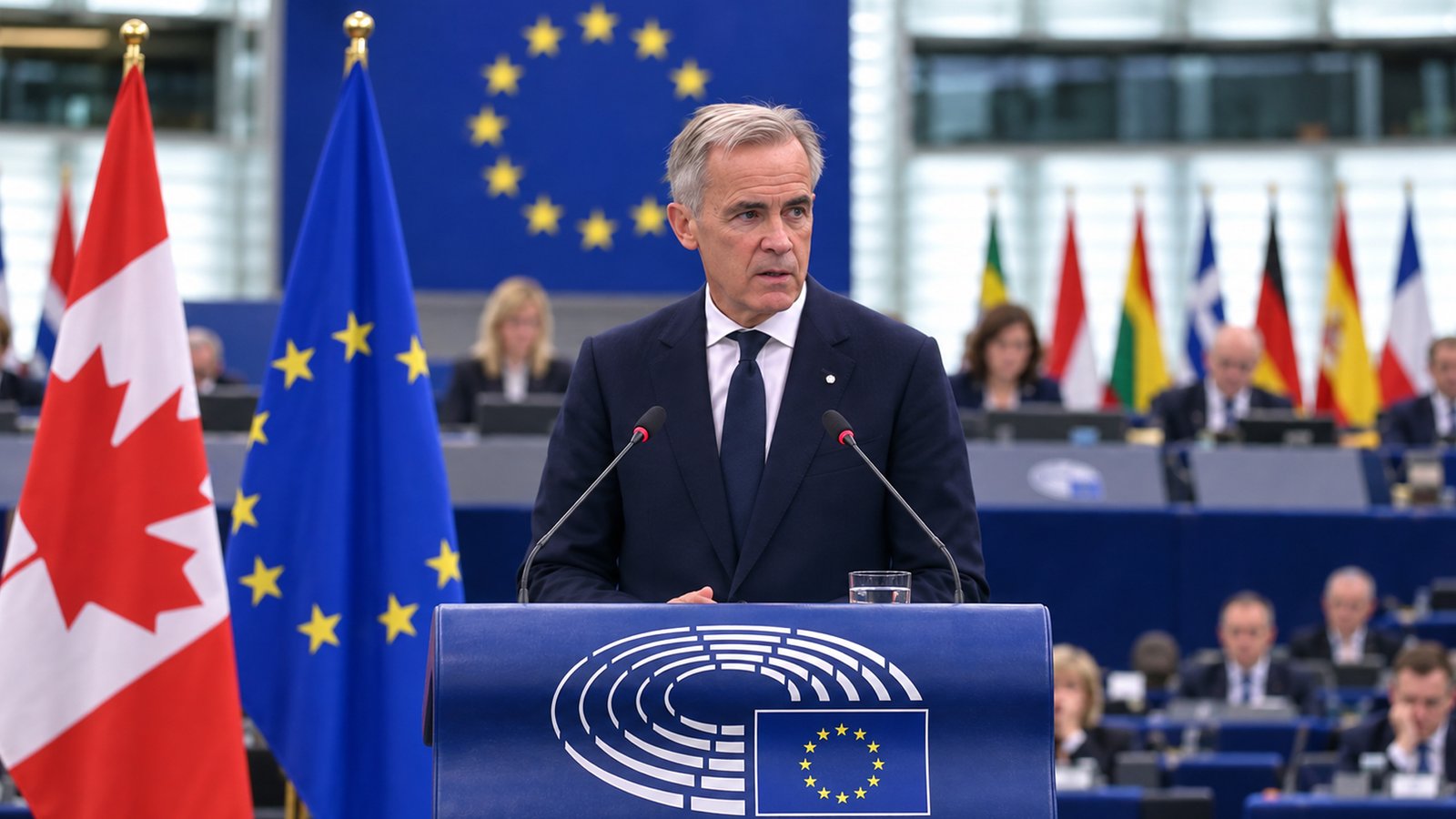
Addressing the European Parliament in Strasbourg on September 17, Carney welcomed European Commission President Ursula von der Leyen’s proposal and said Canada was ready to work with Europe on a deeper partnership. He stressed that Ottawa was not seeking full EU membership, but wanted stronger cooperation across several strategic areas.
The proposed arrangement does not yet have a defined legal framework. The EU currently has association agreements with several countries, but “associate membership” as proposed for Canada would represent a new form of relationship. Any formal arrangement would require approval from the bloc’s 27 member states.
Carney said the focus should be on building practical links rather than getting caught up in the terminology. He outlined possible cooperation in trade, defence, critical minerals, artificial intelligence, energy, space, research and financial services.
The proposal comes at a sensitive time in Canada-US relations. President Donald Trump has criticised the idea and warned that Washington could impose heavy tariffs on the European Union if it considers the Canada-EU arrangement hostile to American interests.
Trump has called the proposal “laughable” and said the United States could impose additional tariffs or restrict trade with Europe if he believes the arrangement is being pursued with bad intentions.
Carney responded by making clear that Canada would decide its own international partnerships. He argued that a stronger relationship with Europe would improve Canada’s economic resilience and would not be aimed at creating a rival power bloc.
The Canadian prime minister also presented closer European ties as a way to reduce his country’s exposure to economic pressure from any single market. Canada has traditionally depended heavily on the United States for trade, with the two countries maintaining one of the world’s largest bilateral trading relationships.
That dependence has come under pressure since Trump returned to office. His administration has imposed tariffs affecting Canadian goods and has repeatedly pushed for changes in the countries’ economic relationship. Trump has also spoken about Canada becoming the 51st US state, comments that have further complicated relations between Ottawa and Washington.
Carney’s government has responded by seeking new markets and strengthening relationships with other major economies. Europe is central to that strategy because Canada and the EU already have a free-trade agreement and extensive economic links.
The proposed partnership could take those ties further. Canada is particularly interested in cooperation on critical minerals, which are important for batteries, advanced manufacturing and clean-energy technologies. Ottawa also wants closer links in artificial intelligence, energy, digital trade, defence production and research.
Defence cooperation has already increased. Canada has joined the EU’s Security Action for Europe, or SAFE, initiative, which creates opportunities for participating countries to work with European defence industries. Ottawa has also sought closer cooperation with European countries on defence and security.
Energy and Arctic cooperation are other areas where Canada and Europe share strategic interests. Canada has significant natural resources, while European countries are looking to strengthen supply chains and reduce dependence on concentrated sources of critical materials.
The EU has described the proposed relationship as part of a broader effort to strengthen cooperation among like-minded partners. European officials have stressed that closer ties with Canada are not intended to target the United States or any other country.
There are, however, questions about how the proposed associate membership would work. The concept has no established legal definition within the EU, and some European officials have expressed uncertainty about what the arrangement would involve.
Existing EU association agreements vary considerably in scope. A new model for Canada would therefore have to be negotiated and agreed upon by the member states.
Carney has said any eventual agreement would also face scrutiny in Canada, including a vote in Parliament.
The two sides are expected to continue discussions ahead of an EU-Canada summit in Montreal in October. That meeting could provide an opportunity to turn the broad proposal into specific areas of cooperation.
The immediate challenge will be balancing ambition with practical arrangements. Canada wants greater access to European markets and stronger strategic partnerships, while the EU must determine what an associate membership would mean without creating a framework that conflicts with its existing rules.
The proposal has already changed the tone of the Canada-EU relationship. As Ottawa looks to diversify its trade and security partnerships, Europe is emerging as a more important economic and strategic partner.
At the same time, Trump’s tariff warning adds uncertainty to the plan. Carney, however, has indicated that Canada intends to pursue closer European ties while maintaining its relationship with the United States.
The proposed Canada-EU partnership therefore remains at an early stage, but negotiations could shape Ottawa’s trade, defence and foreign policy priorities in the coming years.