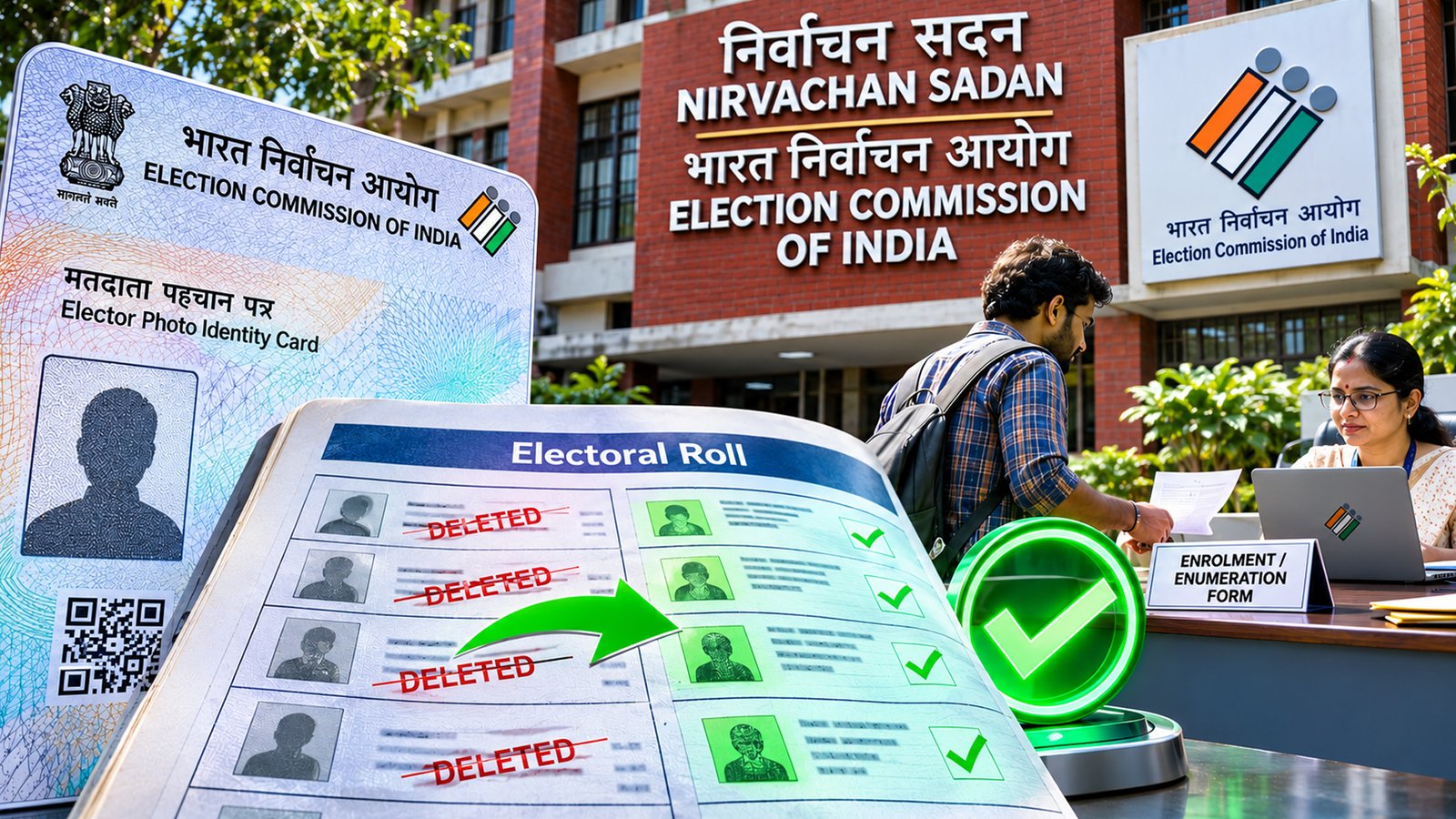
The Election Commission of India (ECI) has given voters left out of the draft electoral rolls in seven states and Union Territories another opportunity to get their names included in the final voter list. The decision comes amid concerns over deletions during the ongoing Special Intensive Revision (SIR) of electoral rolls and growing political criticism of the exercise.
The states and Union Territories covered by the latest directions are Delhi, Haryana, Maharashtra, Andhra Pradesh, Jharkhand, Telangana and Nagaland. Electors whose names were excluded because they were marked absent, shifted, dead or duplicate (ASDD) can now submit their enumeration forms again to seek inclusion in the final electoral roll.
This is significant for voters whose enumeration forms were not received by election officials before the publication of the draft rolls. Instead of being required to register afresh, these electors will be allowed to complete the process through a reopened enumeration window.
According to the Election Commission’s instructions, affected voters will not have to submit Form 6, which is generally used for fresh voter registration, or Form 8 in cases involving a shift of residence within the same state. They can submit their enumeration forms along with a declaration explaining why the documents were not provided earlier.
The Election Commission has clarified that the enumeration window, which closed with the publication of the draft electoral rolls, will be reopened for affected voters until the end of the claims and objections period. The fresh opportunity is intended to ensure that eligible citizens are not denied their voting rights because their forms were not submitted or received during the initial exercise.
Who is eligible for the fresh opportunity?
The additional window covers electors who were categorised as ASDD, an abbreviation for Absent, Shifted, Dead and Duplicate. These classifications are used during the electoral roll revision process to identify voters who could not be verified at their registered addresses or whose entries were considered potentially incorrect or duplicated.
The Commission’s latest directions specifically cover electors who were issued enumeration forms but whose completed forms were not received, leading to their exclusion from the draft electoral rolls. The opportunity is therefore meant to help genuine voters establish their eligibility and regain their place in the electoral register.
Voters who continue to live at the same address can submit their duly completed and signed enumeration forms along with a written statement explaining why they could not submit the documents earlier. The forms can be submitted personally, through a family member or through the online facility available on the ECINET platform.
Those who have moved to another address within the same state or Union Territory will also be allowed to seek inclusion without submitting Form 8. However, they must provide details of their previous address, their new residential address and the Assembly constituency to which they have shifted. Supporting proof of residence must accompany the application.
The Election Commission has also made provisions for homeless voters who may not possess conventional address documents. In such cases, a field verification report prepared by the Booth Level Officer (BLO) can be accepted as proof of residence. This provision is expected to help ensure that vulnerable sections of the population are not left out simply because they cannot produce standard address documents.
ECI directs officials to trace excluded voters
To make the process accessible, the Election Commission has instructed district election officers and Electoral Registration Officers to actively contact affected voters rather than leave the responsibility entirely to individuals.
Partially filled enumeration forms of eligible ASDD electors will be generated again through the ERO dashboard on the ECINET platform. Officials have been asked to ensure that these forms reach the concerned voters either physically or through electronic communication channels, including WhatsApp, SMS and email, wherever contact details are available.
The Commission has also directed Booth Level Officers to conduct house-to-house visits and coordinate with Booth Level Agents representing political parties. They have been asked to make enquiries with neighbours, family members and Resident Welfare Associations to trace voters who could not be contacted earlier.
Additionally, booth-wise lists of electors excluded under the ASDD categories will be displayed again on polling station notice boards. These lists will also be made available on the websites of the respective Chief Electoral Officers in a readable PDF format. They will include the probable reasons why the names were not included in the draft electoral rolls.
This is intended to make the verification process more transparent and give affected voters an opportunity to identify the reason for their exclusion and approach the appropriate election authorities.
What happens after voters submit their forms?
The submitted enumeration forms and accompanying declarations will be examined by the concerned Electoral Registration Officers. Officials will verify the applicant’s eligibility, ordinary residence and other relevant details. Field verification may also be carried out wherever necessary before a decision is taken.
Once an application is approved, the elector will be assigned the same Electoral Photo Identity Card (EPIC) number that was held before the Special Intensive Revision. This means eligible voters will not have to obtain an entirely new voter ID number simply because their names were excluded from the draft list.
The Commission has also clarified that individuals who have already submitted Form 6 for fresh enrolment during the ongoing SIR exercise do not need to submit another enumeration form with a separate declaration. Their applications will be processed under the earlier instructions issued by the poll panel.