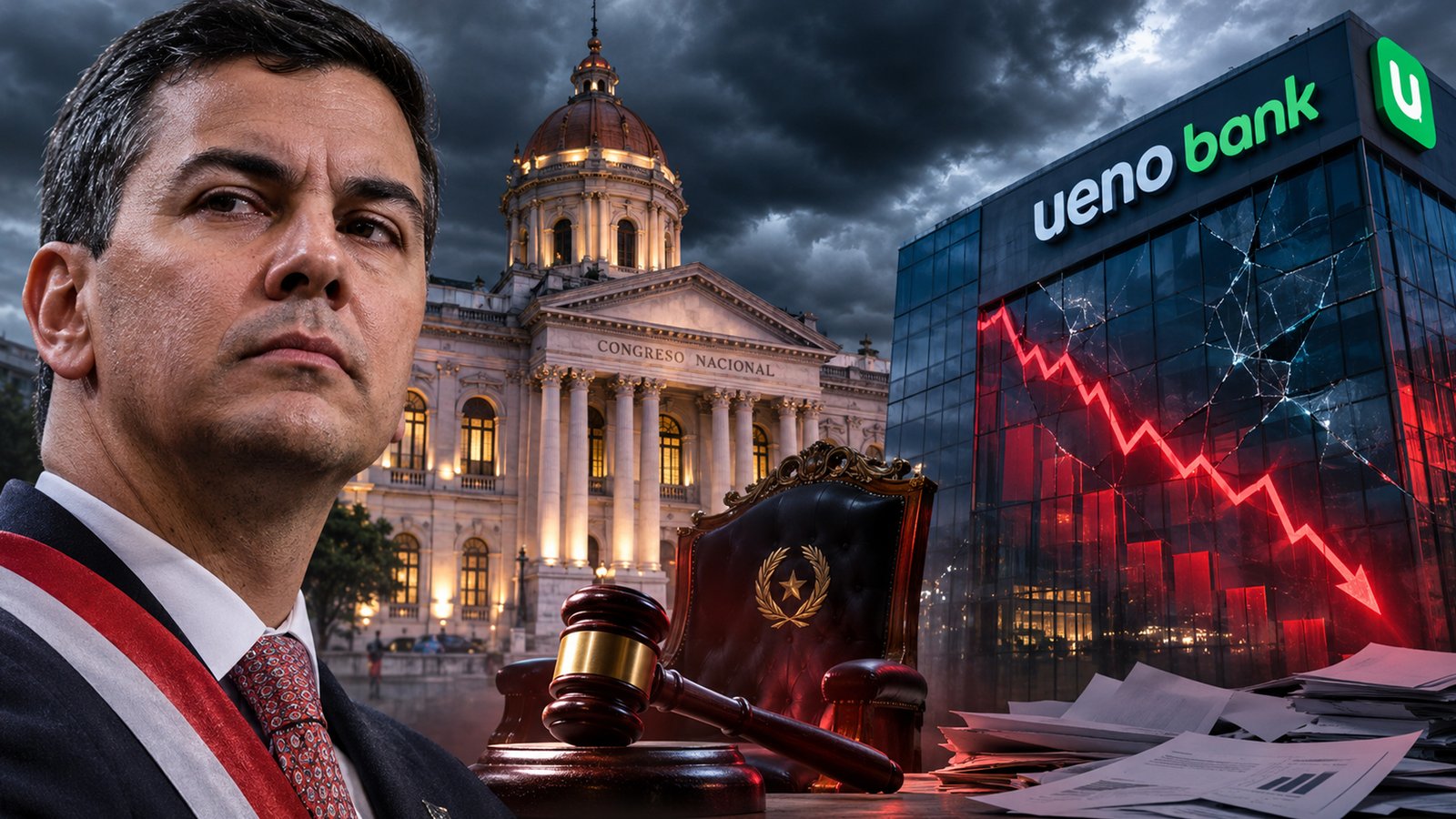
Paraguay has plunged into a major political and financial crisis after President Santiago Peña was impeached and placed under house arrest following the collapse of digital lender Ueno Bank. The banking crisis left millions of customers unable to access their savings and triggered widespread protests, criminal investigations and demands for accountability from the government.
The country’s Senate voted overwhelmingly on Friday, November 6, to remove Peña from office, with 44 of the 45 senators present supporting his impeachment. The lawmakers found him guilty of poor performance in office amid allegations of conflicts of interest and preferential treatment involving the troubled bank. Vice-President Pedro Alliana was subsequently sworn in as the new president and will serve the remainder of the presidential term, which ends in August 2028.
Peña’s removal came just a day after he submitted his resignation amid mounting political pressure. However, lawmakers chose to proceed with impeachment rather than simply accept his resignation. The distinction is significant because former Paraguayan presidents are entitled to lifetime seats in the Senate and certain legal protections unless they are impeached and found guilty.
Following the Senate decision, prosecutors ordered Peña’s arrest as part of an investigation into the banking crisis. Authorities placed him under house arrest while the public prosecutor’s office determines the final charges against him. Former central bank chief Carlos Carvallo is also facing investigation, with an arrest warrant issued against him.
The crisis began when Paraguay’s central bank took control of Ueno Bank on November 3 after discovering serious financial irregularities and a major shortfall in its capital reserves. Regulators found that the bank’s solvency ratio had fallen below half the legally required minimum, prompting authorities to initiate a resolution process to protect depositors and prevent further damage to the financial system.
Ueno Bank had grown rapidly to become one of Paraguay’s largest digital lenders, claiming approximately 2.94 million customers, representing nearly 60% of the country’s adult population. Its expansion was driven by attractive customer offers, digital banking services and an extensive presence across the country.
However, the central bank’s intervention brought its operations to a sudden halt. Customers found themselves unable to access their savings through mobile applications, debit cards and bank transfers, while branches were closed. Long queues formed outside bank offices as depositors tried to withdraw their money. Pensioners, salaried employees and small businesses were among those affected.
The bank also held substantial public-sector deposits estimated at around $800 million, including funds belonging to state institutions and pension and healthcare organisations. Paraguay’s Social Security Institute, known as IPS, reportedly had approximately $355 million deposited with Ueno. The freezing of these funds raised concerns about pension payments and access to healthcare-related resources.
The financial troubles quickly turned into a political controversy because of Peña’s previous business connections with the bank’s parent company, Ueno Holding. The former president had owned shares in the holding company before selling them in April 2025. Opposition lawmakers questioned whether his financial association with the group had influenced government decisions or regulatory oversight.
Impeachment allegations also focused on loans Peña had received from Ueno, the placement of public funds with the lender and the appointment of Carvallo as central bank chief. Carvallo had previously chaired the financial company associated with Ueno before becoming its regulator. Opposition lawmakers questioned the circumstances surrounding the bank’s conversion into a full-fledged banking institution.
The allegations have not yet been established in a criminal trial. However, prosecutors have launched three separate investigations examining possible financial wrongdoing, regulatory failures and the involvement of current and former government officials. Peña has said he would cooperate with the investigations.
The crisis has also led to action against senior executives of Ueno Bank. Prosecutors have charged 27 individuals, including bank officials and business associates, with alleged offences such as breach of trust and attempted fraud. Six senior executives, including founder Miguel Vázquez and bank president Juan Manuel Gustale, were ordered into pretrial detention, while two others were placed under house arrest.
The bank’s collapse has triggered demonstrations across the capital, Asunción, with depositors demanding the return of their savings and action against those responsible. Protesters gathered outside Congress and other government buildings, accusing political leaders and financial executives of failing to protect ordinary citizens. Police used tear gas and water cannons to disperse some demonstrations as public anger intensified.
The crisis has also affected employment, with thousands of workers associated with Ueno and companies within its parent group facing uncertainty over salaries and job security. Employees have joined protests demanding unpaid wages and severance payments.
New President Pedro Alliana has promised that customers affected by the financial collapse will be fully compensated. The government has also moved to accelerate the repayment process through a mechanism that allows eligible depositors to access guaranteed funds. Paraguay’s deposit insurance scheme covers eligible deposits up to approximately $38,000 per person, although customers with larger balances face uncertainty over the recovery of the remaining amounts.
The central bank has maintained that Ueno’s failure is an isolated case and has sought to reassure the public about the stability of the wider banking system.
The coming weeks will be crucial for the new administration as it attempts to stabilise the financial system, address public anger and establish accountability for one of the country’s most serious banking and political crises in recent years.