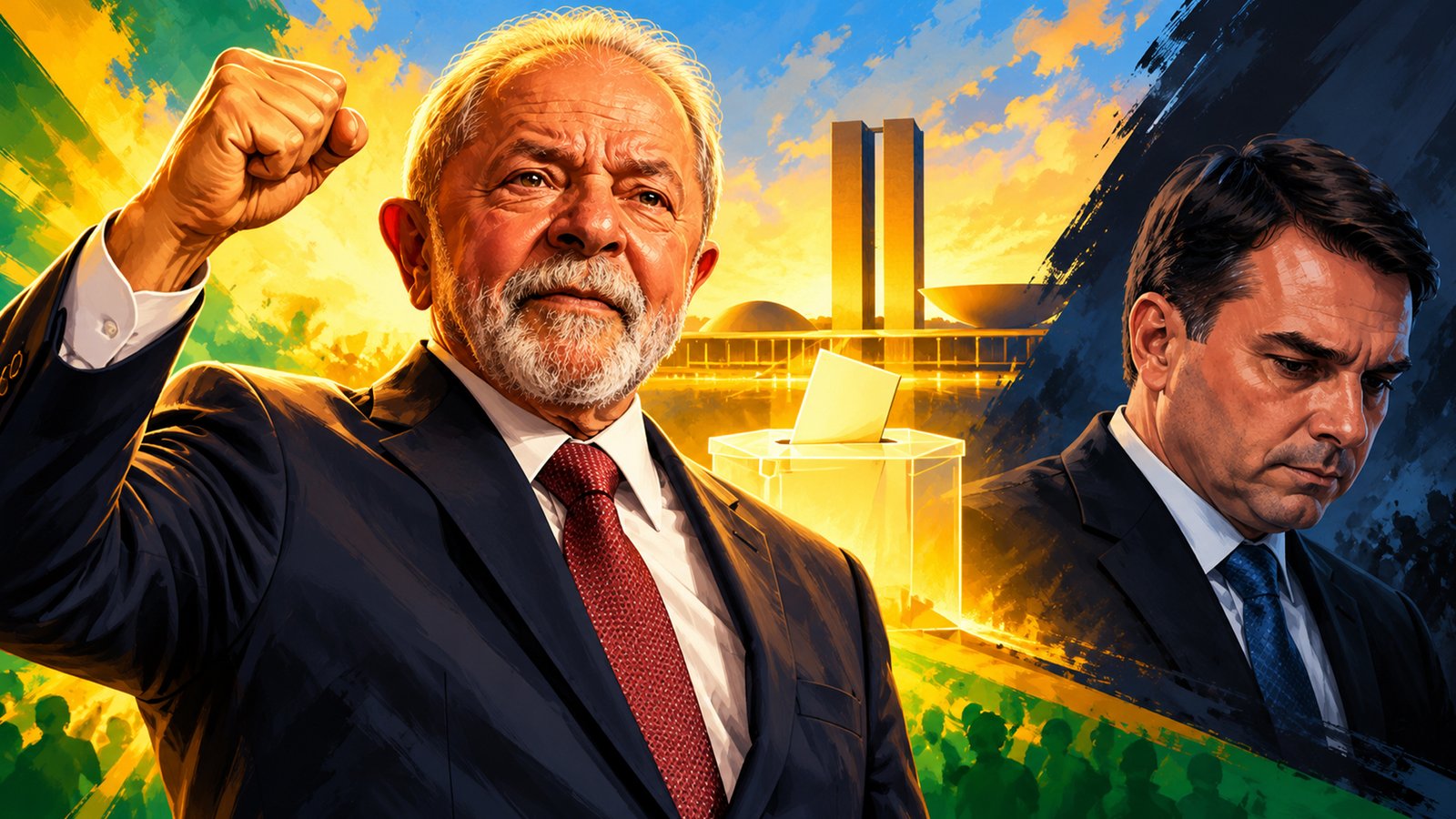
Brazilian President Luiz Inácio Lula da Silva has secured a historic fourth, non-consecutive presidential term, defeating right-wing challenger Flávio Bolsonaro in a closely fought election that highlighted the growing importance of digital campaigning and online political mobilisation. The official results announced by Brazil’s Superior Electoral Court on October 25 showed Lula winning 51.79% of valid votes against Bolsonaro’s 48.21%.
Lula received 64,256,232 votes, while Bolsonaro secured 59,826,041, according to the electoral authority. The victory marks a remarkable comeback for the 80-year-old president, who trailed his younger rival in the first round of voting earlier this month. It also places renewed attention on how political parties use social media, messaging platforms and digital communication to reach voters.
The election offered a notable example of how online campaigning can complement traditional rallies, public meetings and door-to-door outreach. Lula’s campaign intensified its digital efforts during the weeks between the two rounds, seeking to reconnect with supporters and persuade undecided voters to back his economic and social agenda.
One of the most prominent developments was the use of WhatsApp to organise supporters and circulate campaign messages. Brazilian lawmaker André Janones helped establish a group called “Exército de Lula”, or Lula’s Army, which reportedly attracted more than 10 million participants. The network helped amplify pro-Lula messaging and encourage political engagement through a platform widely used across Brazil.
Social media also gave the incumbent a more direct way to communicate with voters. Lula used informal, selfie-style videos and short messages to present his arguments in a format familiar to online audiences. Such content allowed his campaign to reach people beyond conventional political broadcasts, while supporters shared messages and campaign material through their own networks.
The strategy reflected a wider change in political communication. Campaigns increasingly rely on a combination of short videos, messaging groups, digital communities and targeted outreach to keep supporters engaged. These tools can help candidates communicate quickly and mobilise large audiences, although they also raise questions about misinformation, political polarisation and the rapid spread of unverified claims.
Lula’s victory was not guaranteed. In the first round on October 4, Bolsonaro received 47.03% of valid votes, compared with Lula’s 45.16%. Neither candidate crossed the 50% threshold needed to win outright, sending the contest to a runoff. The result initially strengthened Bolsonaro’s position and forced Lula’s campaign to rethink how it could bring more voters into its camp.
In the final weeks, Lula focused on household expenses, employment and social welfare. He also highlighted policies aimed at improving workers’ lives, including a constitutional amendment shortening the working week that was passed during the month. His campaign sought to connect these issues with voters facing financial pressures and uncertainty about Brazil’s economic future.
The final result was closely watched across Latin America, where several recent elections have produced victories for conservative candidates. Lula’s win preserves a left-leaning government in Brazil, the region’s largest economy, and represents a setback for the political movement built by former president Jair Bolsonaro, Flávio’s father.
The election also unfolded amid controversy over voting arrangements. Public transport disruptions were reported in some areas, prompting concerns about access to polling stations. Both campaigns sought an extension of voting hours, and polling stations remained open for an additional two hours. Flávio Bolsonaro subsequently challenged the process and refused to concede, arguing that the extension justified questioning the result.
Brazil’s electoral authority confirmed Lula’s victory after counting the ballots. More than 128 million voters participated in the second round, out of approximately 158.7 million registered voters. Turnout was higher than in the first round, reflecting the intensity of a contest that divided voters over economic policy, public security and the country’s political direction.
Despite his victory, Lula faces significant challenges. Household debt, concerns about crime and dissatisfaction with living costs remain important issues. His administration will also need to work with a Congress expected to include a strong conservative presence, potentially complicating efforts to implement new policies.
Brazil’s election the expanding role of online platforms in modern democracy. WhatsApp groups and social media videos did not replace traditional campaigning, but they provided additional channels for political messaging, coordination and voter engagement. Their effectiveness also underscores the responsibility of platforms, campaign organisations and users to distinguish reliable information from misleading content.
Lula is scheduled to take office for his new term on January 5, 2027. His victory represents both a personal political milestone and a reminder that election outcomes can depend on a combination of economic concerns, grassroots organisation and effective communication. As digital campaigning becomes more sophisticated, Brazil’s election offers another example of technology’s growing influence on how political movements connect with voters.