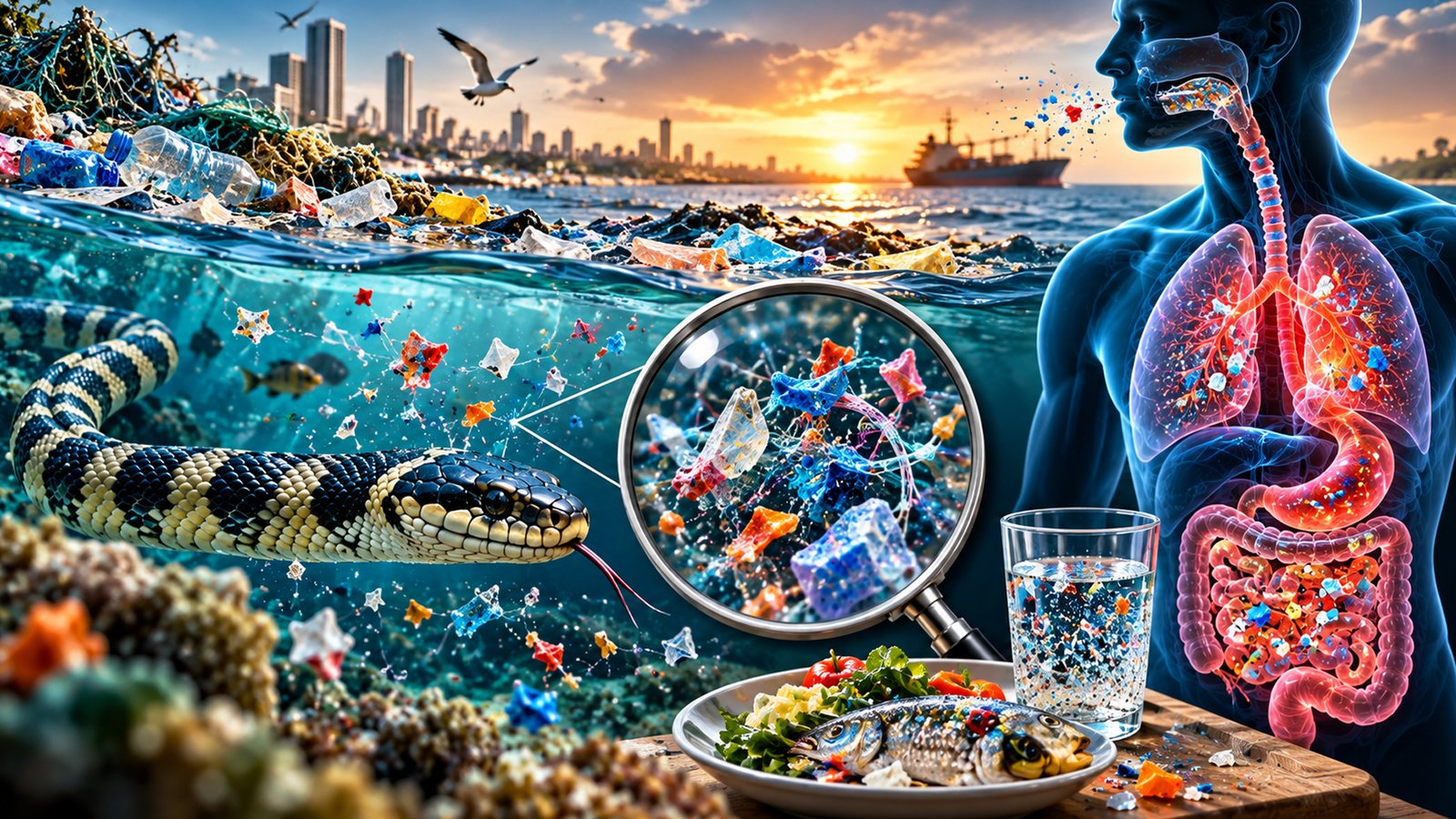
Microplastics, the tiny plastic particles increasingly found in water, food and the environment, may pose a more complex threat than scientists previously understood. Two recent research reports have highlighted different sides of the problem: one study has discovered that microplastics can trigger chemical reactions when they come into contact with water, while another has found the particles in nearly all the sea snakes examined along the coast of Sharjah in the United Arab Emirates (UAE).
Together, the findings add to growing concerns about plastic pollution and its potential effects on living organisms. While neither study provides definitive proof that microplastics cause specific diseases or directly kill wildlife, both offer important clues about how these particles interact with biological systems and spread through marine environments.
Microplastics can trigger chemical reactions
A study published in the journal Nature on October 14, 2026, by researchers from Columbia University and the University of California, Berkeley, challenges the long-held view that plastics are largely chemically inactive.
Scientists found that the surfaces of microplastics can generate reactive oxygen species (ROS) when they come into contact with water. These highly reactive molecules, which include hydroxyl radicals, can alter biological materials and potentially damage cells and tissues.
Plastics are widely used in food packaging, water bottles and everyday products partly because of their chemical stability. However, when larger plastic objects break down into microplastics, their surface area increases significantly in relation to their volume. This creates more surface for interactions with surrounding water.
The researchers found that these water-plastic interfaces can support chemical reactions under ordinary conditions, without requiring the light exposure or added chemical oxidants often associated with plastic degradation.
The experiments also indicated that the effect was not limited to a single material. Researchers observed reactive activity across six common plastics: polyethylene, polypropylene, polystyrene, polyvinyl chloride, polyethylene terephthalate and polymethyl methacrylate. The extent of the activity varied according to the type and surface properties of the plastic. <Cite refs={[“turn807972search2″,”turn807972search4”]}/>
What does this mean for human health?
The discovery offers a possible explanation for how microplastics might affect living organisms beyond their physical presence in the body. Reactive oxygen species can damage cellular components when produced in excessive amounts, making their formation around plastic particles an important area for further investigation.
Microplastics have already been detected in drinking water, food and human tissues. Researchers have also examined possible links between exposure and health problems, including cardiovascular conditions. However, the precise mechanisms behind these associations remain under investigation.
The new study does not establish that microplastics cause particular diseases in humans. Much of the evidence concerns laboratory experiments, and scientists still need to determine how these reactions behave under real-world conditions, including inside the human body.
The findings could nevertheless help researchers develop safer materials. Understanding how different plastic surfaces interact with water may allow manufacturers to design products that produce fewer harmful reactions as they age or break down.
Microplastics found in 95% of sampled sea snakes
A separate study has highlighted the extent of plastic pollution in marine wildlife. Researchers examined 63 dead, stranded sea snakes representing six species along the Arabian Gulf and Gulf of Oman coasts of Sharjah.
Microplastics were detected in 60 of the 63 snakes, equivalent to approximately 95.3% of the sample. The researchers identified 390 particles in total, with fibres accounting for 96.9% of those particles.
The study, titled Microplastic ingestion in sea snakes: Examining age-related exposure and regional differences, was published online in November 2025 in the Journal of Hazardous Materials: Plastics and appeared in the journal’s February 2026 issue. It is among the first published investigations into microplastic ingestion by sea snakes. <Cite refs={[“turn807972search0″,”turn807972search1”]}/>
The research covered six species, including Arabian Gulf coral reef sea snakes and yellow-bellied sea snakes. The specimens had been collected between 2018 and 2021 through Sharjah’s programme for responding to stranded marine animals.
The researchers found that nylon and polypropylene were the main polymers identified in the analysed particles. Nylon accounted for about 80% and polypropylene for 20% of the polymer profile. The high proportion of fibres led the researchers to suggest that domestic laundry wastewater could be one possible source of contamination.
However, the study did not trace the particles to a specific pollution source. The proposed connection with laundry wastewater remains a possibility rather than a confirmed explanation.
More research is needed
The sea-snake study also examined whether microplastic exposure varied with age and location. Younger snakes and those sampled from the Arabian Gulf showed higher exposure patterns, but the differences were not statistically significant. Larger studies will be needed to establish whether these patterns reflect wider environmental trends.
The research also does not prove that microplastics caused the deaths of the stranded snakes. Because the animals were already dead when collected, the findings establish ingestion but not its direct effects on their health or survival.
The two studies highlight different aspects of a growing environmental challenge. One points to a previously overlooked chemical process at the surface of microplastics, while the other documents widespread ingestion among sampled marine reptiles.
As plastic pollution continues to affect ecosystems, scientists will need to investigate how these particles behave in natural water, how organisms are exposed and whether the chemical reactions observed in laboratories contribute to biological harm.
The findings strengthen the case for reducing plastic waste, improving wastewater management and developing safer materials. They also underline the importance of distinguishing emerging scientific evidence from confirmed health outcomes as research into microplastics continues.