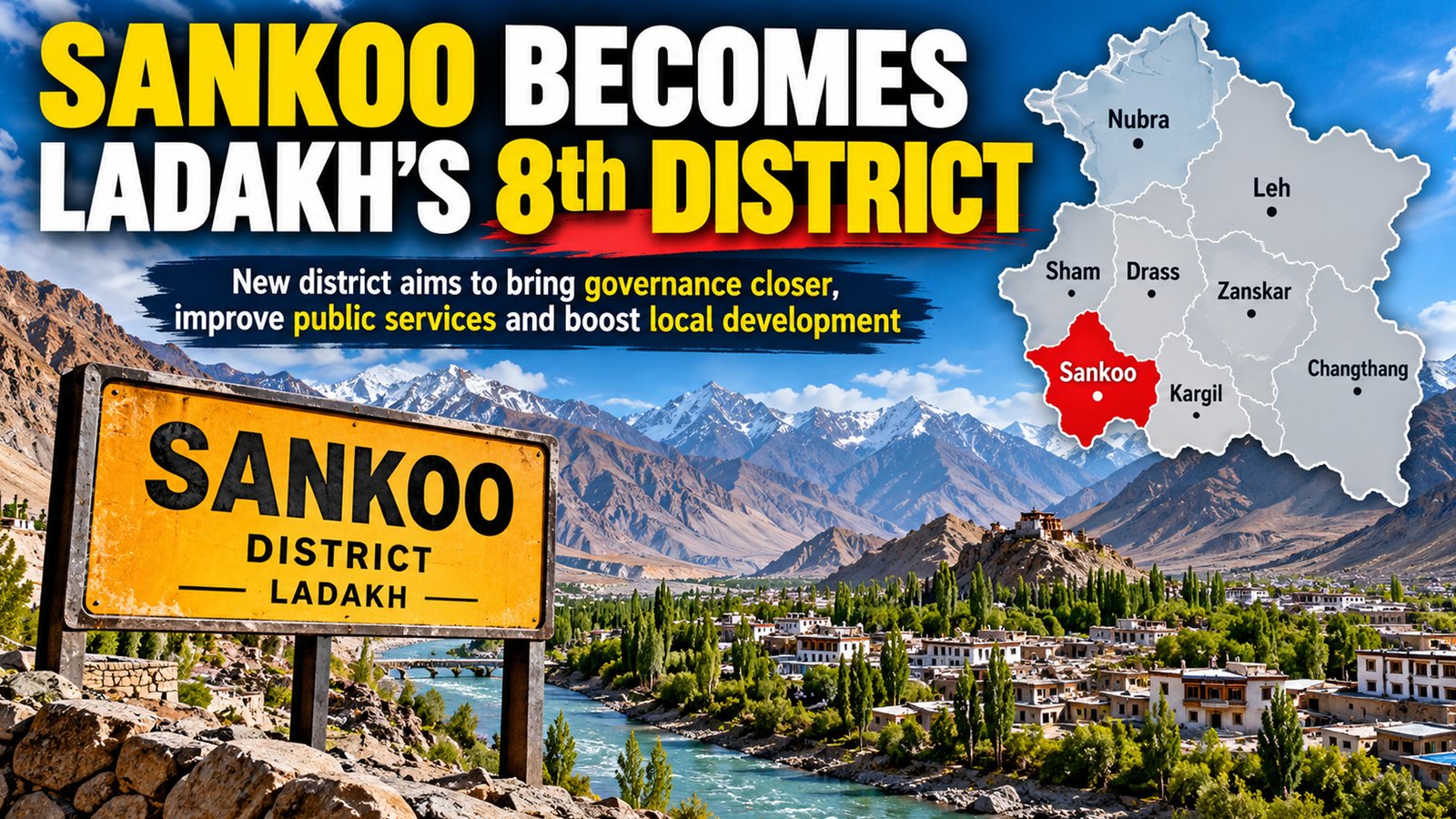
Sankoo has officially become the eighth district of Ladakh, fulfilling a long-standing demand from residents of the Kargil region. The Union Territory administration has also notified a separate Autonomous Hill Development Council for Sankoo, marking a significant step towards decentralising governance and bringing government services closer to people.
Lieutenant Governor Vinai Kumar Saxena announced the decision on Friday, October 16, after receiving approval for the creation of the new district. The administration has formally notified Sankoo as a separate district, with Sankoo town designated as its headquarters.
The development comes less than six months after Ladakh added five new districts in April 2026. With Sankoo’s inclusion, the number of districts in the Union Territory has increased from two to eight. The administration expects the reorganisation to improve public service delivery, strengthen local administration and make development programmes more accessible to residents in remote areas.
The newly created Sankoo district has been carved out of Kargil and comprises four tehsils: Sankoo, GM Pore, TSG and Taisuru. The jurisdiction of Kargil district has been modified to exclude the areas that now fall under Sankoo.
The district was notified under the Jammu and Kashmir Land Revenue Act, 1996, as applicable to Ladakh. The administration also issued a separate notification for the Ladakh Autonomous Hill Development Council (LAHDC), Sankoo, under the Ladakh Autonomous Hill Development Councils Act, 1997.
The new council will exercise powers and perform functions prescribed under the law. Elections are expected to be held later, following a formal notification. The change will also reduce the jurisdiction of the existing Kargil Hill Council by transferring the specified areas to the new administrative unit.
The separate council is expected to give local representatives a more direct role in addressing regional development priorities and administrative needs. Officials will also be appointed to make the district administration functional.
The creation of Sankoo district follows years of demands from residents, local organisations and political representatives. Sankoo is among the more populous areas of Kargil, and residents have sought a separate district to reduce the difficulties associated with accessing government offices and services.
The demand gained renewed attention after the administration announced five new districts in April but left Sankoo out of the list. The decision had disappointed several local representatives, who argued that the region also deserved separate administrative status.
In March, a delegation led by Kargil Hill Council Chief Executive Councillor Dr Mohammad Jaffer Akhoon and Ladakh MP Haneefa Jan met Union Home Minister Amit Shah to seek district status for Sankoo and Shakar-Chiktan.
The approval for Sankoo has now addressed one of those demands, although no similar announcement has been made for Shakar-Chiktan.
Saxena said the decision reflected the aspirations of local residents and acknowledged the contribution of community organisations and political representatives who had worked towards the demand.
Alongside the creation of Sankoo district, the Ladakh administration has approved five new tehsils to strengthen grassroots administration across the Union Territory.
The new tehsils are Aryan Valley in Sham district, Sodh in Kargil, Phey in Zanskar, Thasgam in Drass and Himya in Changthang. These additions will take Ladakh’s total number of tehsils to 37.
The new administrative units are intended to make revenue-related work and other government services more accessible to residents. The changes are particularly relevant in Ladakh, where difficult terrain, long distances and harsh weather can make travel to administrative centres challenging.
The administration has also transferred the powers of the Additional Deputy Commissioner, Durbuk, to the Sub-Divisional Magistrate, Durbuk, to improve access to local administration.
Together, these measures form part of a wider effort to reorganise Ladakh’s administrative structure and improve the delivery of public services.
Until April 2026, Ladakh had only two districts, Leh and Kargil. The administration subsequently created five districts — Nubra, Sham, Changthang, Zanskar and Drass — taking the total to seven. Sankoo is the latest addition.
Ladakh became a Union Territory in October 2019 following the reorganisation of the former state of Jammu and Kashmir. Since then, questions surrounding local governance, political representation and constitutional safeguards have remained central to discussions about the region’s future.
The latest announcement comes amid continuing talks between Ladakh representatives and the Centre over constitutional safeguards and the region’s governance structure. A recent round of discussions ended without a breakthrough, with another meeting expected on October 22.
The creation of Sankoo district is expected to reduce the administrative distance between residents and government offices. A separate district administration and hill council could help local authorities respond more directly to regional needs and coordinate development work.
However, the benefits will depend on how quickly offices are established, officials appointed and administrative responsibilities transferred. The separate hill council’s functioning will also depend on the formal arrangements for its elections.