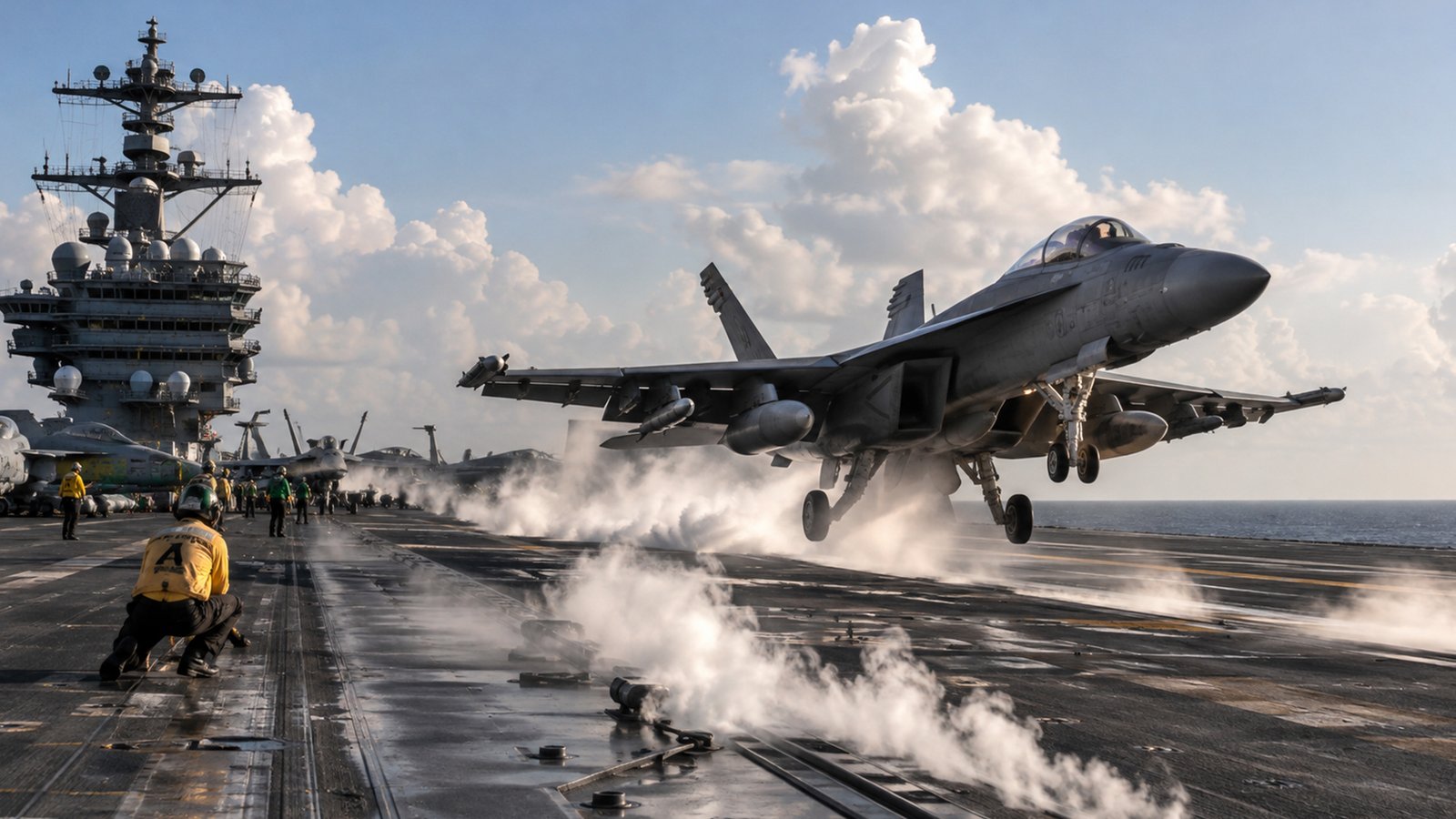
President Donald Trump has ordered the US Navy to abandon the electromagnetic system used to launch fighter jets from its newest aircraft carriers and return to traditional steam-powered catapults, reviving a technology the Navy spent decades moving away from.
The directive, issued through a national security memorandum, targets future Gerald R. Ford-class aircraft carriers, beginning with the under-construction USS Doris Miller. The order also calls for the replacement of the Ford class’s advanced electromagnetic weapons elevators with hydraulic systems. The Pentagon has been given 60 days to submit a plan covering the redesign, timelines and funding requirements.
The decision could add hundreds of millions of dollars to the programme and potentially run into billions when the wider costs of redesign, integration and delays are considered. The change is particularly significant because work on the Doris Miller is already well advanced, with the electromagnetic launch system reportedly well into production.
Trump has criticised the Electromagnetic Aircraft Launch System, or EMALS, for years. He has repeatedly argued that the technology is unnecessarily complicated and has expressed a preference for the older steam system. His latest decision turns that longstanding criticism into a formal policy for future carriers.
EMALS was developed to replace steam catapults on the Ford class and was intended to make aircraft launches more efficient while reducing the manpower and maintenance burden associated with the older technology. Instead of using steam pressure to drive a piston, EMALS uses electromagnetic energy to accelerate an aircraft along the carrier’s flight deck.
The technology was introduced with the USS Gerald R. Ford, the lead ship of the class, and has subsequently been incorporated into other Ford-class carriers. The system has completed more than 36,000 aircraft launches, according to Reuters, while the Wall Street Journal reported that the number has reached about 37,000.
That record has become central to the debate over Trump‘s decision. Supporters of the switch argue that steam catapults are a proven technology with decades of operational experience. Trump has also questioned whether the newer electromagnetic system offers enough practical benefit to justify its complexity.
Navy officials and defence experts, however, have raised concerns about reversing course after the US military invested heavily in EMALS. Returning to steam would require substantial redesign of a carrier whose architecture was built around electromagnetic launch and recovery systems. It would also mean bringing back equipment that requires more sailors and is generally more labour-intensive to operate and maintain.
The timing is another concern. The Ford-class was designed as the US Navy’s next-generation aircraft carrier, with greater automation and improved electrical capacity compared with the older Nimitz-class ships. EMALS was part of that broader effort to modernise carrier operations and reduce the crew required to run them.
The decision also comes as the United States faces pressure to expand its naval fleet while dealing with long-standing shipbuilding delays and capacity constraints. Trump’s memorandum therefore goes beyond the catapult dispute. It also directs the Pentagon to establish a fifth public shipyard focused on repairing submarines and aircraft carriers.
At the same time, the memorandum allows the Navy, under certain conditions, to have some ships built overseas. The move is intended to increase shipbuilding capacity and accelerate deliveries, reflecting Trump’s wider push to expand the US naval fleet.
The catapult reversal also has a broader strategic dimension. China has developed electromagnetic launch technology for its newer aircraft carriers, making the issue more than a question of engineering preference. France has also adopted EMALS for its future next-generation aircraft carrier plans.
The US Navy, has to now decide how much of the Ford-class design must be altered and how quickly the changes can be implemented without further disrupting the carrier programme. The Pentagon must now prepare the detailed plan ordered by Trump, including the cost and schedule implications.
The existing Ford-class carriers already built or substantially progressed are not simply being converted overnight. The directive primarily affects future construction, with the USS Doris Miller identified as the first major test of the new approach.
The controversy ultimately reflects a larger tension in defence procurement: whether the military should continue investing in sophisticated technologies that promise long-term advantages or rely on systems with decades of operational history.