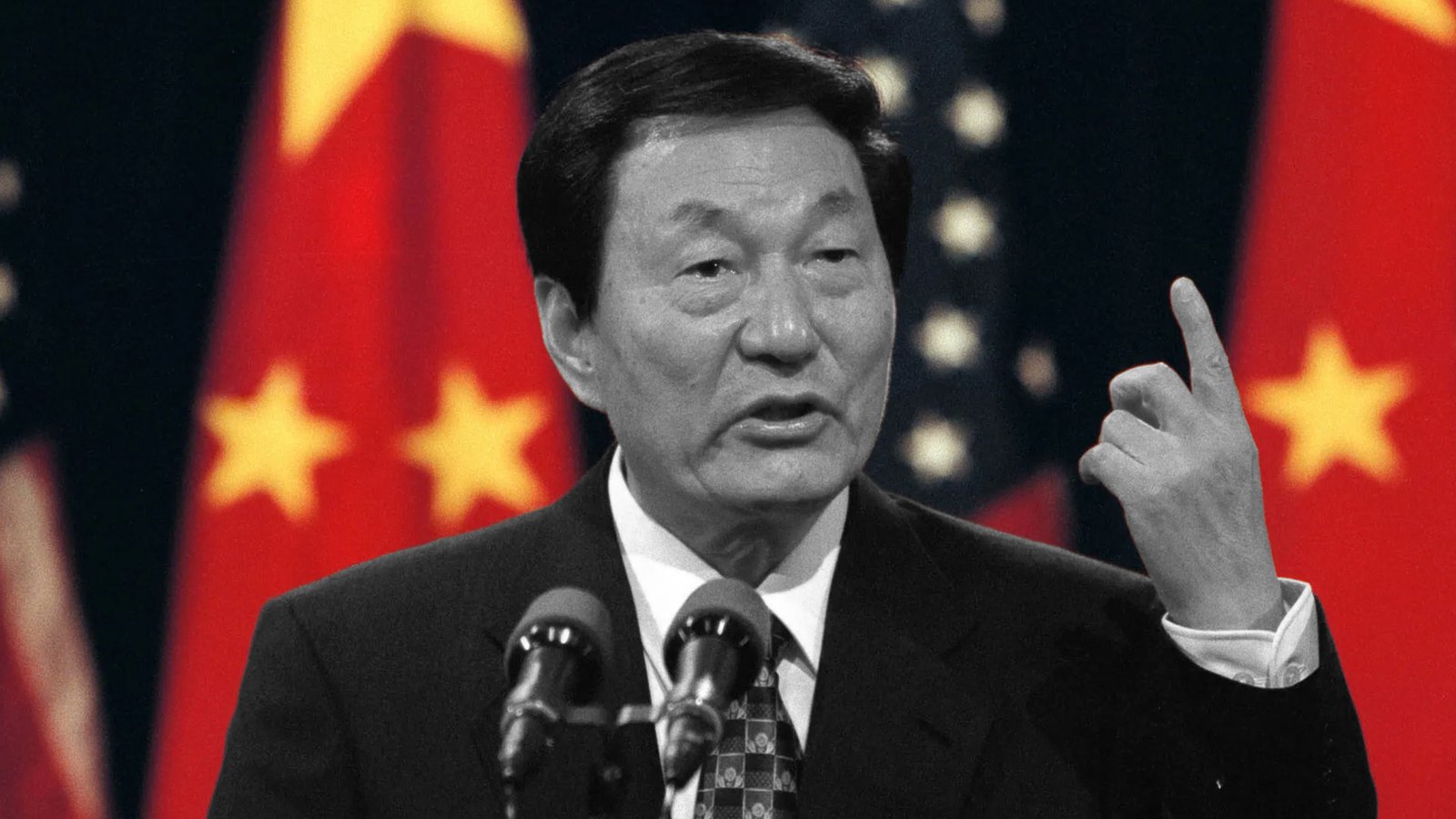
Former Chinese premier Zhu Rongji, one of the key architects of China’s economic transformation and the country’s entry into the World Trade Organization (WTO), has died at the age of 97, state media reported. Zhu died in Beijing on August 12, 2026, after an illness. His death marks the passing of one of the most influential Chinese economic policymakers of the late 20th century.
Zhu served as China’s premier from 1998 to 2003, a period when the country was undergoing sweeping economic and social changes. Known for his blunt manner, sharp political instincts and reputation as a tough administrator, he played a central role in moving China further away from its centrally planned economic system and towards a more market-oriented model.
His tenure coincided with a period of rapid economic expansion that eventually helped establish China as a major force in the global economy.
Zhu was born in Changsha, Hunan province, in October 1928. He studied electrical engineering at Tsinghua University and joined the Communist Party of China in 1949, the year the People’s Republic of China was founded. His early political career was disrupted by the political campaigns of the Mao era, but he later returned to public life and gradually rose through the party hierarchy.
His reputation as an economic manager grew during his time in Shanghai. Zhu became mayor of the city in the late 1980s and later served as the city’s Communist Party chief. During this period, he gained national attention for his efforts to modernise Shanghai, attract investment and improve its infrastructure.
He was subsequently brought into the national leadership and appointed vice premier in 1991. As the country’s senior economic policymaker, Zhu became closely associated with efforts to tackle inflation, strengthen government finances and reform state-owned enterprises.
When he became premier in 1998, China was facing major economic challenges. State-owned companies were struggling, banks carried large amounts of problematic loans and millions of workers faced uncertainty as inefficient industries were restructured.
Zhu pushed ahead with reforms despite the social cost. His government undertook a major restructuring of state-owned enterprises, resulting in widespread layoffs but also making many companies more commercially viable. He also strengthened central government control over taxation and public finances and supported reforms in the financial and housing sectors.
The reforms were controversial. Workers affected by state-sector restructuring faced job losses and reduced security, while critics argued that the transition created new inequalities. Supporters, however, viewed Zhu’s policies as necessary steps towards building a more competitive Chinese economy.
One of Zhu’s most important achievements was helping negotiate China’s entry into the WTO. China formally joined the organisation in December 2001 after years of negotiations and substantial changes to its trade and economic policies.
Zhu strongly supported the move despite concerns within China that opening the economy further to international competition could hurt domestic industries. His government accepted significant commitments on tariffs, market access and other areas in order to secure membership.
The decision proved transformative. WTO membership helped accelerate China’s integration into global supply chains, boosted exports and encouraged foreign investment. Over the following decades, China emerged as one of the world’s largest manufacturing and trading powers.
Zhu’s economic legacy, however, remains complicated. His reforms helped generate rapid growth, but some of the structures created or strengthened during his tenure later produced difficulties for China.
The country’s heavy reliance on exports also became a source of vulnerability as global trade tensions increased in later years. These issues have become particularly relevant as China now attempts to strengthen domestic consumption and address problems involving local government debt and the property sector.
Still, Zhu remained widely respected for his willingness to confront difficult economic problems. His reputation was markedly different from the more cautious public style often associated with Chinese political leaders. He was known for speaking directly and sometimes sharply, earning a reputation as an impatient but determined reformer.
Ahn leaves behind a filmography that stretches across generations of Korean television viewers. His final drama, Love Doctor, is now set to become a farewell of sorts — one last opportunity for audiences to experience the quiet, character-focused storytelling that made Ahn Pan-seok one of the most respected names in Korean drama.