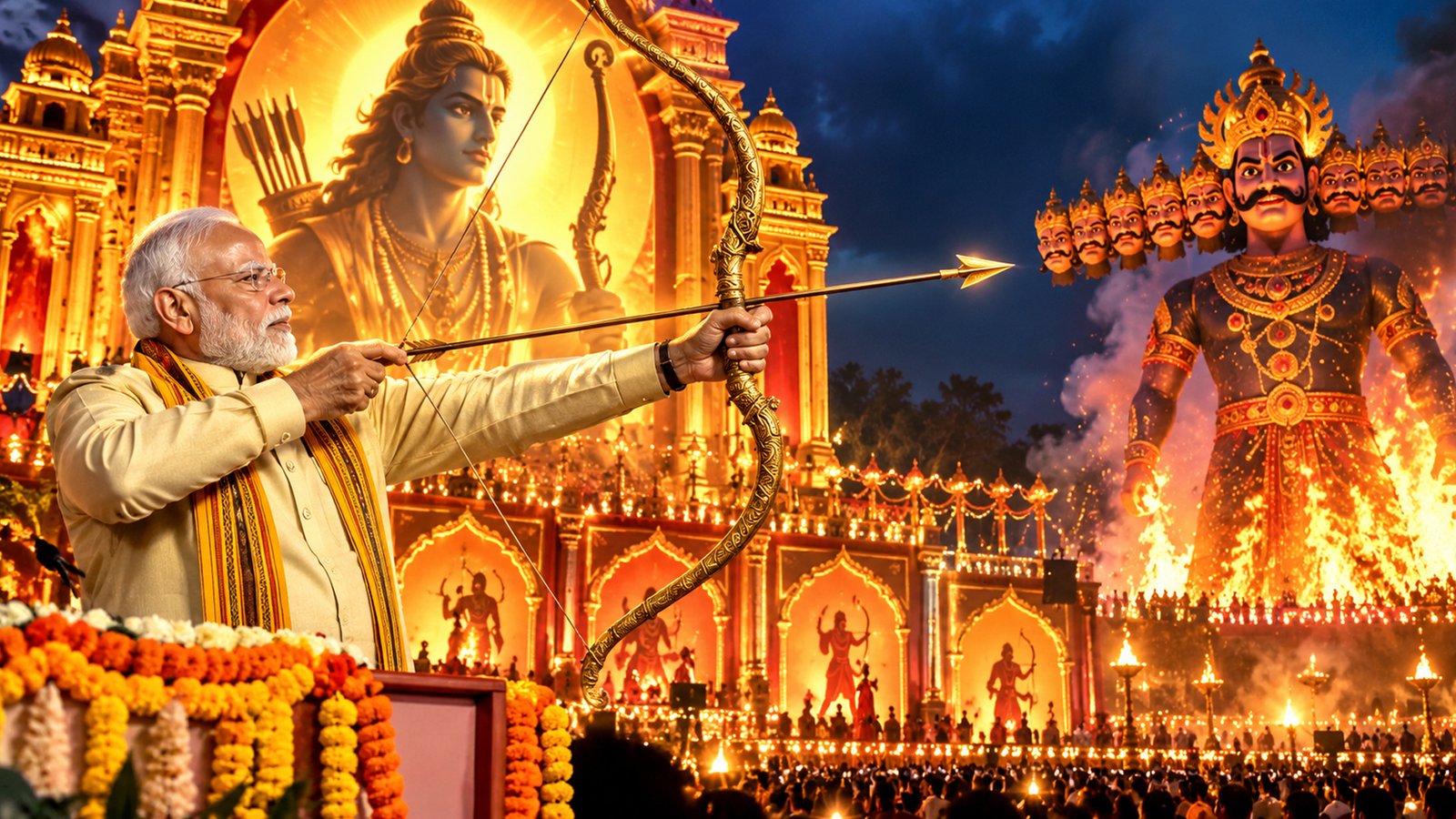
Prime Minister Narendra Modi called for national unity, self-reliance and good governance during Dussehra celebrations in New Delhi on Tuesday, October 20. Invoking the ideals of Lord Ram, PM Modi urged political parties, national institutions and citizens to put the country first and stand together against forces that seek to divide society or undermine India’s cultural identity.
President Droupadi Murmu also attended Dussehra celebrations in the national capital, extending festive greetings to citizens and highlighting the values people can learn from Lord Ram’s life. The two leaders took part in separate events as the country celebrated Vijayadashami, which marks the victory of good over evil.
PM Modi attended the Vijayadashami celebrations organised by the Shri Ramlila Committee Indraprastha at the DDA Utsav Ground in IP Extension, east Delhi. His address focused on the message of Dussehra, the principles of Ram Rajya and the need for collective effort to build a developed India.
In his address, PM Modi said the country must identify and defeat forces that harm India’s honour and dignity, create divisions in society or express hatred towards its culture. He urged all political parties and national institutions to work together in the national interest.
He said the spirit of Vijayadashami teaches people that truth and humanity can overcome even powerful challenges. The festival, he added, offers an opportunity to renew the country’s commitment to unity and collective progress.
PM Modi also stressed that India should have faith in its own strength and resources rather than depend on others to overcome difficulties. He called for turning national resolve into practical action through hard work and self-reliance.
The Prime Minister’s remarks linked the traditional message of Dussehra with present-day challenges, placing national unity, cultural identity and confidence in India’s capabilities at the centre of his appeal.
PM Modi invoked the concept of Ram Rajya to explain his vision of governance based on justice, equality and public welfare. He said Lord Ram’s ideals offered lessons for building a society where people receive equal opportunities and are treated fairly.
According to the Prime Minister, the purpose of power should not be limited to ruling but should focus on improving people’s lives. He described public welfare as a central principle of Ram Rajya and linked it to the government’s goal of building a developed India, or Viksit Bharat.
The reference to Ram Rajya brought the religious and cultural significance of Dussehra into the discussion of governance. PM Modi’s message emphasised that the values associated with Lord Ram should guide public life, social responsibility and the country’s development.
He also spoke about India’s efforts to preserve its cultural heritage. Referring to the return of ancient idols and artefacts from abroad, he said more than 650 ancient idols had been brought back to India over the past 12 years. He also pointed to the growing international recognition of India’s cultural sites.
President Droupadi Murmu attended Dussehra celebrations in Dwarka, Delhi, where she extended greetings to the nation on Vijayadashami. She said Ram Leela performances organised in India and abroad help people remember the principles and values represented by Lord Ram.
The President also highlighted the importance of environmental protection, saying people could learn lessons about conserving nature from Lord Ram’s life.
Her message added an emphasis on compassion, responsibility and respect for the environment to the festival’s wider significance. Dussehra is celebrated in different parts of India through traditions that reflect the triumph of good over evil, including the victory of Lord Ram over Ravana and the victory of Goddess Durga over Mahishasura.
The festival brings together religious observances, cultural performances and community celebrations. The participation of the President and Prime Minister in Delhi’s events underlined the national significance of Vijayadashami.
PM Modi’s address also stressed that difficult circumstances should not prevent India from pursuing its development goals. He urged citizens and institutions to work with confidence and a shared sense of purpose.
The emphasis on self-reliance reflects a broader national policy focus on strengthening domestic capabilities, improving economic resilience and reducing dependence on external support in critical areas. His appeal for political parties to unite in the national interest also placed cooperation above differences when addressing major national challenges.
At the same time, the Prime Minister’s remarks about forces that divide society and attack India’s cultural identity formed a strong political message within his Dussehra speech.