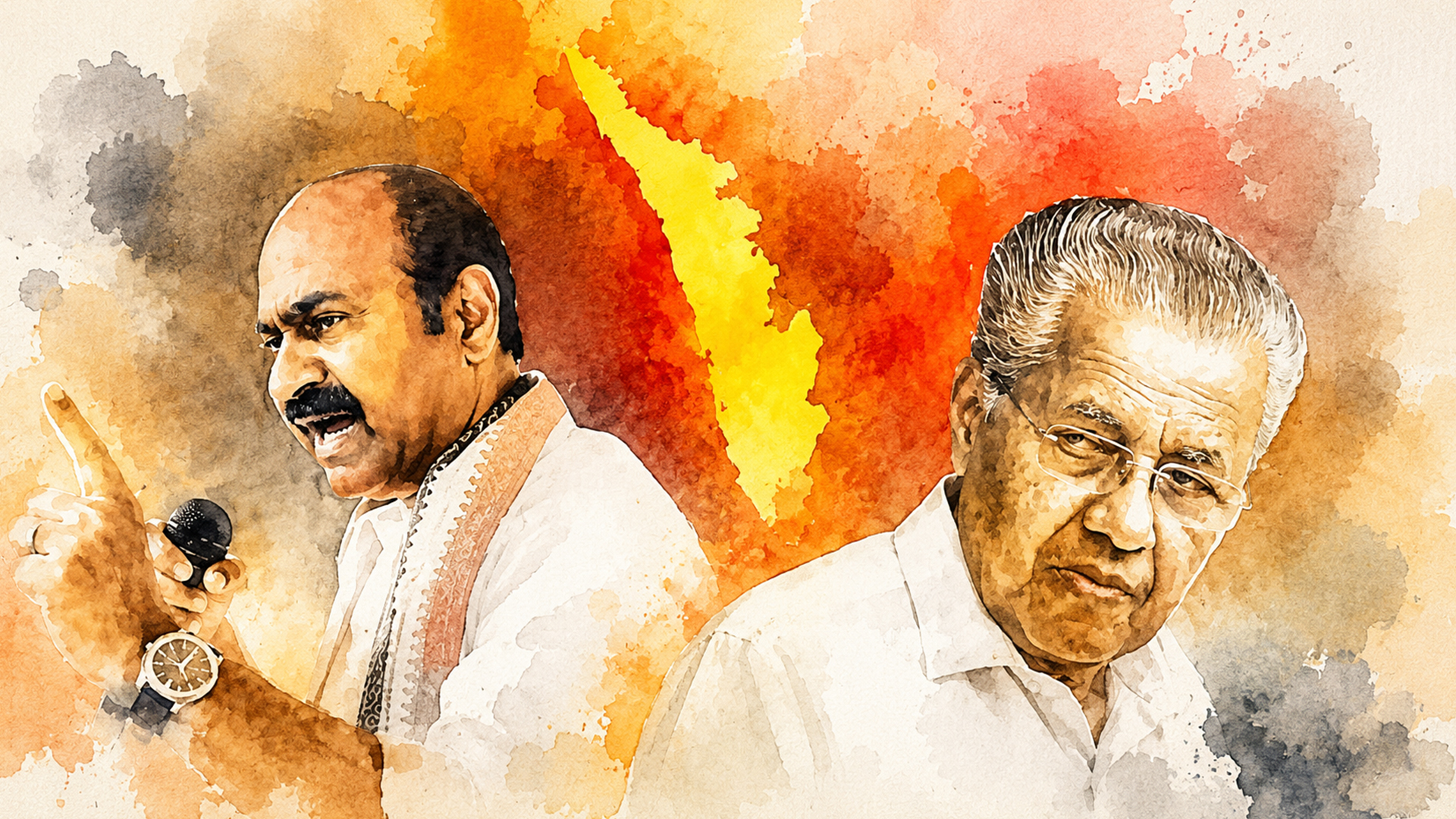
Barely two months after the formation of the V.D. Satheesan government, Kerala’s political discourse has taken an unexpected turn. Instead of policy decisions, administrative initiatives, or political campaigns dominating the headlines, both the ruling Congress-led United Democratic Front (UDF) and the opposition CPI(M) have found themselves battling controversies generated within their own ranks.
The immediate trigger for the Congress has been the escalating confrontation between Chief Minister V.D. Satheesan and Kerala Students Union (KSU) president Aloshious Xavier. What began as differences over the appointment of government leaders has evolved into a full-fledged political controversy, drawing in senior Congress leaders and eventually prompting intervention from the party high command. For a government still in its honeymoon phase, the prolonged public exchange has inevitably diverted attention from its governance agenda and handed the Opposition an opportunity to question the ruling coalition’s internal cohesion.
Ironically, even as the Congress grappled with its own crisis, the CPI(M) found itself answering uncomfortable questions over an entirely different controversy.
The party’s mouthpiece, Deshabhimani, was forced to delay the publication of its weekend supplement, which carried commemorative articles on the first death anniversary of former Chief Minister V.S. Achuthanandan. Officially attributed to technical reasons, the delay soon gave way to reports of an editorial dispute over a proposed feature on theatre activist “Kallan Vijayan” ( thief Vijayan). Concerns were reportedly raised that placing the article, carrying the prominent title “Kallan Vijayan”, alongside V.S. memorial pages could invite political ridicule and unwanted interpretations.
The controversy deepened after Deshabhimani Resident Editor M. Swaraj denied that any such article had been prepared, only for the theatre activist himself to state publicly that the newspaper had collected his details and photographs for publication. The supplement was eventually released on Monday with the piece on Achuthanandan, but the article on “Kallan Vijayan” was dropped altogether, while the CPI(M) is now expected to conduct an internal inquiry into the episode.
The two controversies differ in substance. The Congress episode revolves around a contemporary leadership dispute with direct political consequences, while the Deshabhimani episode concerns editorial judgement within a party publication. Yet both underline a familiar reality of Kerala politics: internal disagreements often assume a public life of their own, overshadowing the issues parties intend to highlight. The episode reflects the wider questions of political messaging, party unity and public perception that are examined across our opinion and analysis coverage.
For the Congress, the focus has shifted from governing to managing perceptions of unity. For the CPI(M), what was meant to be a solemn remembrance of one of its tallest leaders became a debate over editorial decisions that inadvertently revived memories of the long-standing tensions between Pinarayi Vijayan and V.S. Achuthanandan.
In politics, perception often travels faster than intent. And when internal narratives eclipse political messaging, it is not merely individual leaders but the party’s larger image that invariably pays the price.