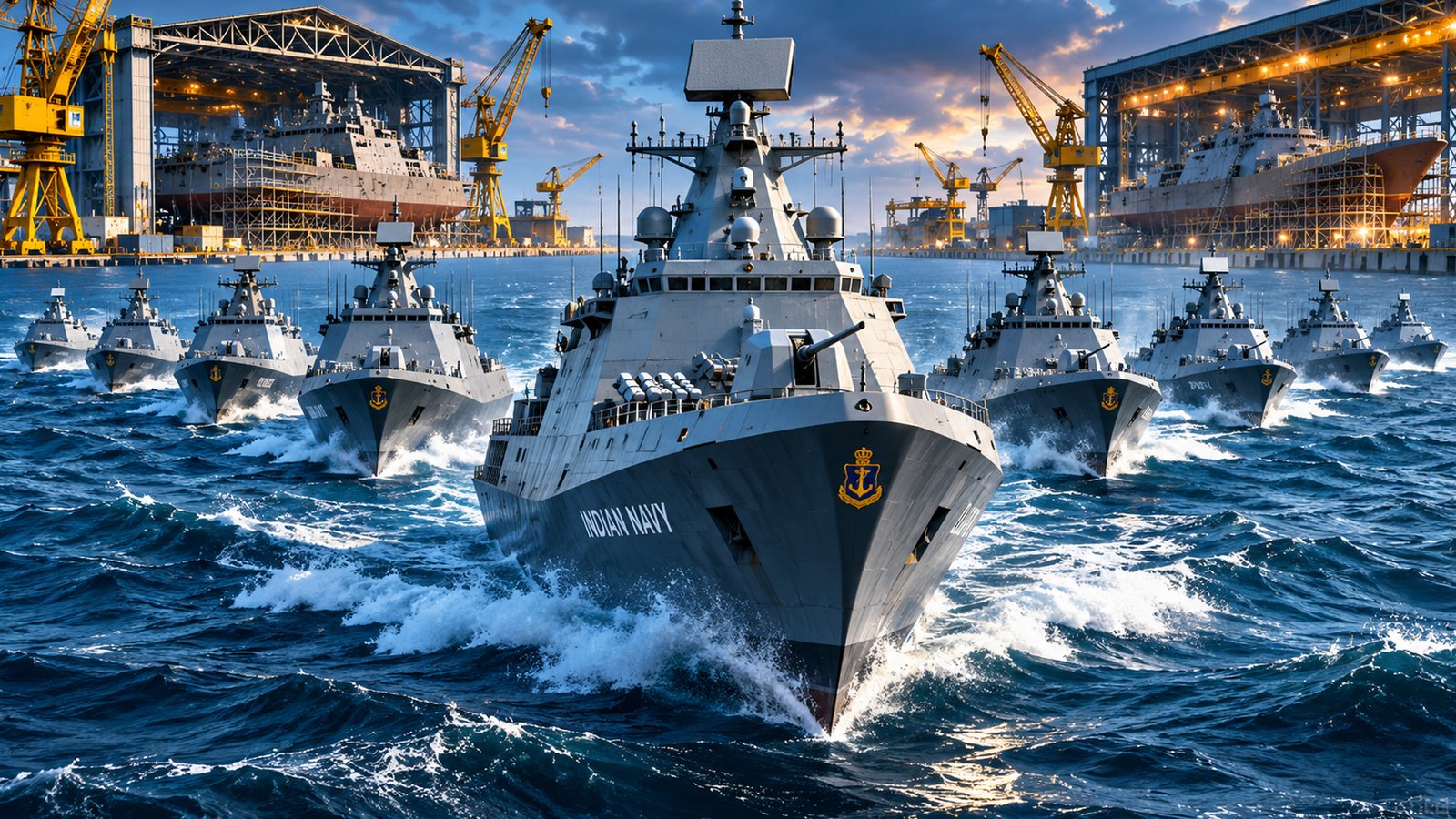
India has taken another major step towards strengthening its naval capabilities and domestic defence manufacturing, with the Ministry of Defence signing contracts worth ₹53,866.50 crore for eight Next Generation Corvettes for the Indian Navy. The agreement will see two state-owned shipyards build the advanced warships, which are expected to improve India’s ability to protect its maritime interests and secure important sea routes.
The contracts were signed on November 2 in New Delhi in the presence of Defence Secretary Rajesh Kumar Singh. Garden Reach Shipbuilders and Engineers Limited (GRSE), based in Kolkata, will construct five corvettes, while Goa Shipyard Limited (GSL) will build the remaining three.
The project is significant because it marks the first time that warships designed indigenously by the Indian Navy will be constructed by defence public sector undertakings (DPSUs) selected through a competitive bidding process. The government said the arrangement reflects the growing capabilities of India’s shipbuilding industry and its push to reduce dependence on foreign suppliers for critical defence platforms.
The eight vessels will be equipped with advanced missiles, weapons and sensor systems. These capabilities will allow them to operate across air, surface and underwater domains, giving the Navy greater flexibility during different types of missions.
The Next Generation Corvettes are expected to play several roles, including anti-surface warfare, anti-submarine warfare, coastal defence and littoral combat operations. They will also support maritime surveillance, presence missions and the protection of commercial shipping routes.
Corvettes are relatively compact surface combatants compared with larger destroyers and frigates, but modern versions can carry sophisticated weapons and sensors. Their size and operational flexibility make them useful for coastal operations, escort duties and missions in strategically important waters.
For the Indian Navy, the new vessels will add to its ability to monitor maritime activity and respond to emerging threats. Safeguarding sea lanes is particularly important for India, given the country’s dependence on maritime routes for trade, energy supplies and other essential imports.
The procurement also comes at a time when India is seeking to strengthen its presence across the Indian Ocean Region. The Navy has been expanding its fleet and upgrading its capabilities to address traditional naval threats as well as changing security challenges at sea.
The project is expected to provide a major boost to the domestic shipbuilding ecosystem. The construction work will involve not only the two main shipyards but also private shipbuilding companies, equipment manufacturers, component suppliers and smaller industrial units.
According to the Defence Ministry, the construction of the eight corvettes is expected to generate around 72 lakh person-days of employment at the shipyards over the next 10 years. Another 460 lakh person-days of employment are expected to be created in ancillary industries and micro, small and medium enterprises (MSMEs).
The scale of the project is expected to benefit a wide network of Indian businesses involved in supplying materials, machinery, electronic equipment and other components required for naval platforms. It could also provide opportunities for smaller companies to become part of the country’s defence supply chain.
Defence Minister Rajnath Singh said the project would strengthen collaboration between defence public sector undertakings, private shipyards and Indian industrial partners. He also highlighted the importance of using locally manufactured materials, indigenous technologies and Indian expertise.
The contract is part of the government’s wider Aatmanirbhar Bharat initiative, which aims to increase domestic production and reduce India’s reliance on imported military equipment. The Make in India programme has placed particular emphasis on expanding the country’s ability to design, develop and manufacture advanced defence platforms.
The project has been in the pipeline for several years. The Defence Acquisition Council had granted Acceptance of Necessity for the procurement in June 2022, with an estimated cost of around ₹36,000 crore at that stage. The final contract value is higher, reflecting the subsequent procurement process and project requirements. The Cabinet Committee on Security cleared the proposal shortly before the contracts were signed in November 2026.
The order is also an important development for both shipyards. GRSE has a long record of building naval vessels, including frigates, anti-submarine warfare shallow water crafts and survey ships. The five-corvette order further strengthens its position in India’s defence manufacturing sector.
For Goa Shipyard, the contract to build three corvettes is its largest order in terms of value so far. It also reflects the company’s growing role in constructing advanced naval platforms for the Indian armed forces.
The Defence Ministry said the project would strengthen cooperation across the domestic shipbuilding industry and support the development of indigenous technologies. The vessels are expected to enhance the Navy’s operational reach while creating long-term opportunities for Indian manufacturers.
The next challenge will be to complete construction and deliver the ships within the planned timelines. Once inducted, the eight Next Generation Corvettes will add important capabilities to the Indian Navy as it works towards a stronger, more self-reliant fleet.