Prime Minister Narendra Modi has said India’s investments in renewable energy over the past decade helped the country manage the economic impact of the ongoing West Asia crisis, highlighting the growing importance of clean power in strengthening national energy security. He said the country’s economic growth remained strong despite global disruptions and warned that excessive dependence on fossil fuels could leave economies vulnerable to future shocks.
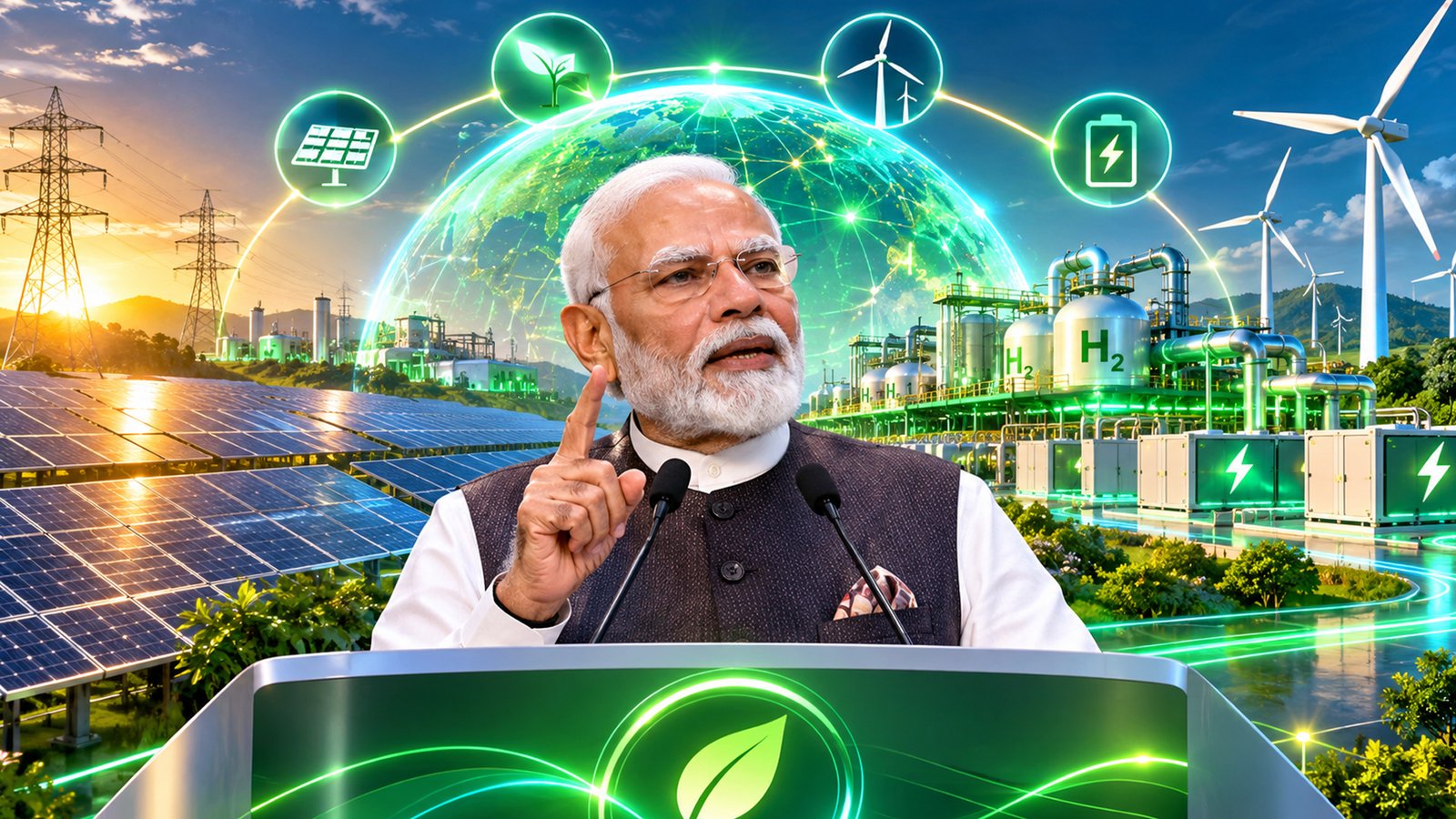
PM Modi made the remarks while inaugurating the four-day Bharat Renewable Energy Summit and Expo 2026 at Bharat Mandapam in New Delhi on November 2. The event, being held from November 2 to 5, brings together policymakers, investors, industry leaders and technology companies to discuss the future of renewable energy. Its theme is ‘Invest. Innovate. Inspire.’
The Prime Minister said the global economy had faced several major challenges, from the Covid-19 pandemic to the continuing conflict in West Asia. According to him, India’s clean energy investments and the systems developed around them over the past decade had helped reduce the severity of the impact.
He pointed out that energy security and economic security were closely connected. Countries that depend heavily on fossil fuels remain exposed to supply disruptions and price fluctuations, particularly when energy resources are concentrated in a few regions. Clean energy, he said, offered a more sustainable way to reduce such vulnerabilities.
India has already achieved nearly 300 gigawatts (GW) of non-fossil installed power capacity, with more than 50% of its total installed electricity capacity coming from non-fossil sources. The country achieved its Paris climate commitment of sourcing half its installed power capacity from non-fossil sources in 2025, five years ahead of the 2030 deadline.
PM Modi said India was now aiming to add another 500 GW of non-fossil energy capacity over the next 10 to 11 years. This is an additional long-term ambition beyond the country’s existing target of achieving 500 GW of non-fossil capacity by 2030.
The renewable energy sector is also expected to attract significant investments. PM Modi said the sector had received more than ₹15 lakh crore over the past decade, including over ₹6 lakh crore in the two years since the 2024 RE-INVEST summit. He projected investment opportunities of more than ₹20 lakh crore by the end of the decade.
Union Minister for New and Renewable Energy Pralhad Joshi also highlighted the pace of investment, saying the sector had attracted more than $67 billion over the past two years. The government is looking to draw further domestic and international funding into solar, wind, green hydrogen, energy storage and transmission infrastructure.
The summit has participation from more than 130 countries, including over 40 ministers. Nine countries and the European Union are participating as country partners, while 13 Indian states and Union Territories are showcasing their renewable energy potential. More than 400 exhibitors are presenting technologies and solutions across the clean energy sector.
A major focus of PM Modi’s address was the expansion of rooftop solar power. The PM Surya Ghar Muft Bijli Yojana, launched in February 2024 with a target of installing rooftop solar systems in one crore households, has already attracted more than 65 lakh households, he said.
The Prime Minister noted that around one lakh new households were joining the programme every six days. A study cited by him indicated that the scheme had reduced electricity bills by roughly 76%. Some households were also earning money by selling surplus electricity generated by their rooftop solar systems to the power grid.
He also highlighted the use of solar energy in public infrastructure and agriculture. More than 44,000 government buildings have been connected to solar power, resulting in annual savings of nearly ₹700 crore. Under the PM-KUSUM scheme, solar irrigation facilities have reached more than 30 lakh farmers. PM Modi said beneficiaries of solar pumps could save close to ₹1 lakh annually.
The government is also looking to expand solar power beyond conventional rooftop installations and irrigation pumps. PM Modi urged startups, Indian Institutes of Technology, researchers and entrepreneurs to develop solar-powered solutions for household cooking, electric vehicle charging, agriculture and dairy operations.
He called for greater innovation in battery storage and technologies that can ensure reliable solar power even when sunlight is unavailable. The development of affordable storage systems, he said, would create opportunities for Indian manufacturers and young entrepreneurs.
Domestic manufacturing has emerged as another important part of India’s renewable energy strategy. Solar module manufacturing capacity has grown from around 2 GW a decade ago to more than 200 GW, while domestic solar cell manufacturing capacity has reached nearly 40 GW. The expansion is aimed at reducing import dependence and strengthening India’s position in the global clean energy supply chain.
PM Modi also highlighted the National Green Hydrogen Mission, which aims to develop domestic production of green hydrogen and support its use across industries and transport. India has set a target of producing 50 lakh tonnes of green hydrogen annually by the end of the decade.
The Prime Minister said the country’s clean energy transition would create employment across manufacturing, installation, maintenance, transportation and related services. He also announced that India had proposed a $200-million Africa Solar Facility to support solar energy development in African countries.